
The most flattering tinted moisturizer isn’t necessarily the one that covers the most. Tinted facial moisturizers add a touch of colour for a natural-looking complexion, but choosing one can be tricky when shade names, coverage descriptions, and finish claims don’t tell the whole story.
If you’re weighing tinted moisturizer against foundation or BB cream, start with what you want the product to do and what you still need from the rest of your skincare and makeup routine. That makes it easier to judge whether a tint-led formula fits your everyday preferences.
This guide breaks down coverage, finish, shade, and formula so you can compare options using practical criteria. You’ll learn how to find a natural-looking match, understand what a tinted moisturizer can and can’t replace, and decide where it fits in your routine. Avin & Holy Glow offers tinted facial moisturizers, giving you options to explore as you narrow down what you want.
Key Takeaways
- Set your preferred coverage first, from a sheer tint to more noticeable complexion coverage.
- Use finish labels as clues, not guarantees, since formulas can look different on your skin.
- Compare tinted facial moisturizers by shade, formula details, and how you want them to fit your routine.
- Choose between tinted moisturizer, foundation, and BB cream based on each product’s role and your coverage preference.
- Apply to clean, prepared skin and follow the product’s directions for a considered everyday look.
What Are Tinted Facial Moisturizers, and What Can They Do?
A tinted facial moisturizer is a moisturizer-format product with tint intended to add light, sheer-looking complexion coverage. It brings together a skin-colored makeup element and a moisturizer format, but the balance of tint and moisturizing properties varies by formula.
That distinction matters. The word “moisturizer” describes a product category, not a promise that every formula hydrates equally or replaces your regular moisturizer. For a general overview of the category, see Moisturizer. Think of the tint as makeup coverage, and assess any skincare benefits separately by reading the product details.
For a related perspective on tinted options, watch this video:
How tinted moisturizer fits into an everyday makeup routine
Treat it as a complexion product: it adds tint, but doesn’t automatically replace other skincare or makeup steps. You might choose it when you want a lighter layer than your usual foundation, or as the complexion step in a simple everyday look. The appeal is the possibility of a natural-looking finish, not a guaranteed result. Appearance depends on the formula, shade, application, and your skin.
Keep the roles clear. Coverage can even the appearance of your complexion, but that doesn’t mean a product treats dryness, blemishes, or another skin concern. Continue using skincare steps that meet your needs, and don’t assume the tinted product provides sun protection unless its own labeling says so. A tinted formula may simplify makeup without making every other routine step unnecessary.
Who may prefer a sheer complexion product
A sheer option may appeal if you prefer a lighter alternative to fuller-coverage foundation, want your natural complexion to remain visible, or don’t enjoy the feel of a more substantial makeup layer. It can suit everyday wear when subtle tint is closer to your goal than extensive coverage.
Start with your preferences, not a rule about age or skin type. You might want a sheer veil of colour one day and more coverage on another. Consider how a product feels during wear, how much visible coverage you like, and whether its stated finish suits your taste. No single formula suits every person or concern.
Use the product description to compare its stated purpose with what you want from your routine. If coverage is your priority, a sheer option may not meet it. If you want a lighter complexion product, tinted facial moisturizers are worth considering. Keep your moisturizer and other skincare choices tailored to your skin.
How Coverage, Finish, Shade, and Formula Change the Result
A product’s result depends on several choices, not one label. Coverage describes how much tint shows on the skin; finish describes how the surface looks; shade is about matching depth and undertone; and formula refers to the product’s overall composition and feel. Each detail answers a different question, and together they shape the result.
Shade, coverage, and finish are separate selection criteria. Assess each on its own before deciding whether the combination suits you. This makes product descriptions easier to compare and helps prevent a flattering finish label from distracting you from a shade or coverage mismatch.
Choosing a finish and coverage level
Sheer usually signals a light veil of tint, while light coverage suggests a little more visible colour. Neither term guarantees that blemishes or uneven areas will be concealed. Coverage is a spectrum, so compare the stated level with how much of your natural complexion you want to remain visible.
Compare finish and coverage clues
Finish describes appearance, not the amount of tint. A dewy label suggests a more luminous look, a natural label signals less pronounced shine or matteness, and matte points toward a less reflective appearance. These terms aren’t standardized guarantees, and the result can vary by formula and skin.
For a useful comparison, look at product descriptions and swatches under consistent lighting. If one image is brightly lit and another is in shadow, their apparent coverage and finish may be difficult to compare. Look for descriptions of how much tint is visible, then consider whether the surface appearance matches your preference. Don’t treat a finish word as a promise about wear or skin benefits.
Finding a shade that looks natural
Shade matching has two parts. Depth describes how light or deep a shade appears; undertone refers to the subtle warm, cool, or neutral quality beneath that surface colour. Two shades with similar depth can still look different if their undertones don’t match yours.
When possible, blend a small amount along the jawline and check the result in daylight. A wrist swatch alone may be misleading because the skin there can differ in colour from your face. Look for a shade that transitions naturally between face and neck rather than choosing by a name or online image alone.
For makeup for women of colour, the same two-part check applies: compare shade depth and undertone independently rather than assuming one describes the other. If swatches are available, view them side by side in consistent light. A shade that looks close in a small dab may appear different when blended across a larger area, so take time to assess the overall match.
As you narrow your preferences, browse the tinted facial moisturizer range and compare each product’s stated details.
Tinted Moisturizer vs. Foundation and BB Cream: What Should You Choose?
These complexion products can overlap, so the label alone won’t tell you exactly how a formula will look or feel. Start with your priority: a tint-led touch of colour, complexion coverage, or the particular functions described for a BB cream. Formulas vary within each category, so use the product description rather than assuming every product type performs the same way.
The table offers a starting point. Treat “typical role” as a general guide, not a guarantee about an individual formula.
| Product type | Typical role | Coverage preference | Shopper priority |
|---|---|---|---|
| Tinted moisturizer | A moisturizer-format product with tint | Often considered for a lighter, tint-led look; check the stated coverage | A subtle complexion product and a preferred finish |
| Foundation | A complexion product generally chosen when coverage is central | Compare the specific coverage description | Making complexion coverage the main makeup goal |
| BB cream | A separate complexion category with functions that vary by formula | Use the product’s stated coverage as your guide | Understanding the specific functions described for that formula |
When a tinted moisturizer may fit better than foundation
If you’d rather see more of your natural complexion than wear a coverage-focused base, a tinted moisturizer may be worth considering. Compare the stated coverage, finish, and how comfortable you expect the formula to feel. A tint-led product isn’t automatically the right choice for every preference, and you shouldn’t assume its coverage will conceal particular concerns.
Foundation is generally the more direct starting point if complexion coverage is your main priority. Still, foundation formulas differ, just as tinted formulas do. Read the product description for its coverage and finish, then choose according to the look you want, not a fixed rule that one category is always heavier or better.
How BB cream fits into the comparison
BB cream is its own category, but the functions described can vary from one formula to another. Don’t assume every BB cream offers the same coverage, feel, or skincare-related claims. Compare the actual description with your priorities, and treat each stated benefit as specific to that product rather than to the whole category.
For a closer look at the category and its terminology, explore the complete BB cream guide. It can help you consider BB cream on its own terms, then return to the comparison with a clearer sense of what you want from a complexion product.
Ultimately, choose by the result you’re seeking: tint-led coverage, complexion coverage as the main priority, or the stated functions of a BB cream. If a lighter tint sounds right for your everyday makeup, browse the tinted facial moisturizer selection and compare each product’s listed details with your preferences.
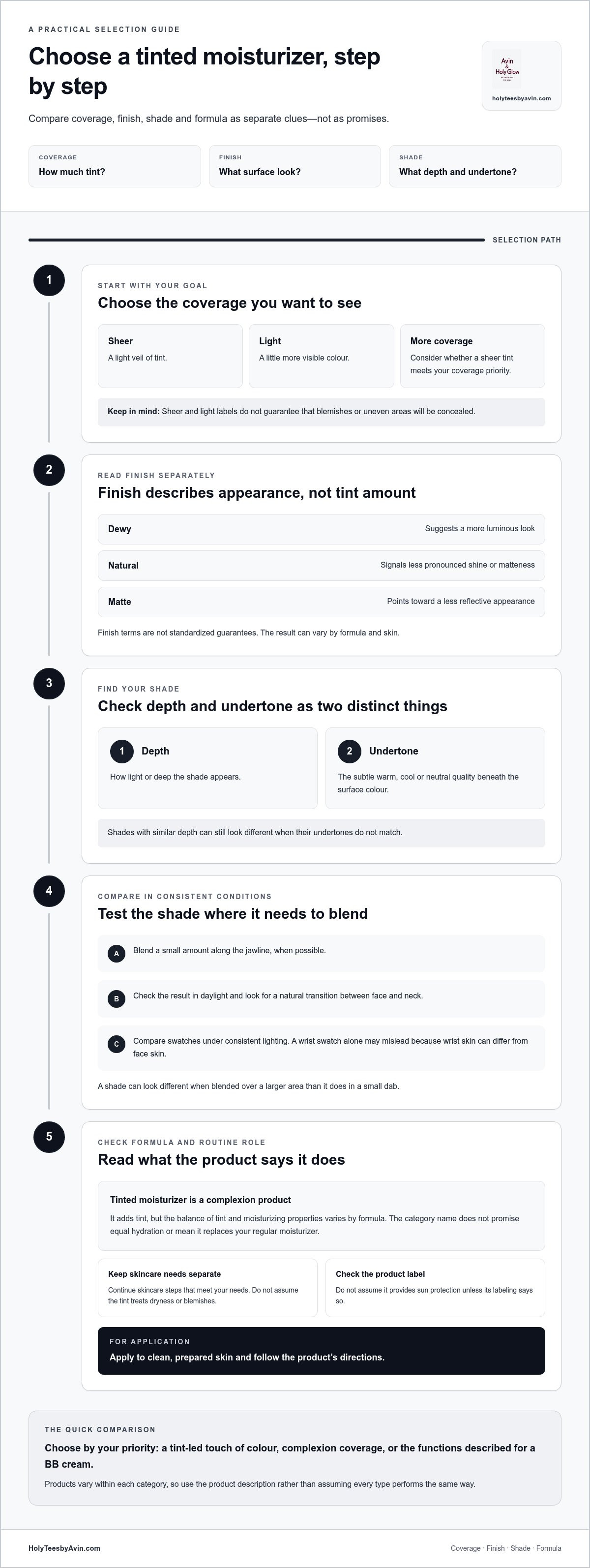
How to Choose and Apply Tinted Facial Moisturizer
A confident choice starts with your priorities, then moves to careful application. Use this sequence to compare options without assuming every formula works the same way.
- Set your coverage goal. Decide whether you want a subtle veil of tint or more visible complexion coverage. Compare that preference with the coverage stated in the product description.
- Identify your finish preference. Consider whether you’re drawn to a dewy, natural, or matte appearance. Treat those labels as useful clues, not guarantees of how the formula will look on your skin.
- Compare shade options. Look at shade depth and undertone, and use available swatches as a guide. If you can try a shade, blend it along the jawline and assess it in daylight.
- Review formula details. Read the full ingredient list if you have personal sensitivities. Check vegan, cruelty-free, or SPF claims on the specific product’s own labeling rather than assuming they apply to every tinted formula.
- Apply as directed. Begin with clean, prepared skin and follow the product’s instructions. Start with a small amount and blend evenly; add more only if the directions allow and you want additional coverage.
A practical checklist before choosing a formula
Before comparing products, note your coverage goal, preferred finish, shade needs, and intended use, such as everyday makeup or a more polished look. This keeps the search focused. Then read each product’s details and ingredient list, especially if you avoid particular ingredients because of personal sensitivities. Base decisions about vegan, cruelty-free, and SPF claims on product-specific labeling.
Your routine can help you decide what “prepared skin” means for you. Cleansing is one step, while a serum may be part of your skincare routine before makeup. For a broader look at layering, the vegan serum guide offers related routine context.
Application and routine order
After cleansing, apply the skincare steps that suit your routine and give them time to settle according to their directions. Use clean hands or an applicator, whichever you prefer and the product instructions allow. Begin with a small amount instead of spreading a thick layer across your face at once.
For an even application, start near the centre of your face and blend outward toward the hairline and jaw. Use light, even strokes, paying attention to the edges so the tint transitions smoothly. If you want more coverage, build gradually only when the product’s directions allow. Adding too much at once can make the result harder to control. If the formula pills, feels uncomfortable, or doesn’t sit as you’d like, pause and reconsider how it fits with your other routine steps.
With your coverage, finish, and shade preferences in mind, explore tinted facial moisturizers and compare each product’s stated details.
Explore Tinted Facial Moisturizers with a Clearer Buying Framework
A clear framework turns browsing into a more considered choice. As you explore tinted facial moisturizers, assess each option by its own product details rather than assuming the category guarantees a particular shade range, finish, ingredient profile, or result. Start with the look you want, then check whether the listing provides information that matches your priorities.
What to compare on an individual product page
Read each listing with the same questions in mind. This makes options easier to compare and keeps appealing wording from standing in for details you need.
- Shade: Review the shades stated for that product. Consider whether the listed options give you useful guidance about depth and undertone.
- Coverage: Look for the product’s own description of how much tint or complexion coverage it offers. Don’t infer coverage from the category name.
- Finish: Use the finish description as a clue to the appearance the product is intended to create, not as a guaranteed result on your skin.
- Ingredients: Read the ingredient information with your personal sensitivities in mind. Evaluate any product claims, including vegan, cruelty-free, or SPF statements, from that specific listing and its labeling.
A category label alone doesn’t establish performance, suitability for a particular skin type, or certification. Holy Tees by Avin offers tinted facial moisturizers and vegan facial moisturizers as separate categories, so don’t assume a tinted option shares attributes stated for a vegan facial moisturizer. Use the ingredients and claims listed for the individual product.
Make the choice reflect your everyday priorities
Keep your decision sequence simple. First, decide how much coverage you want. Next, identify the finish you prefer. Then compare shade options, review formula details, and consider how the product fits with your existing routine. This order helps you focus on what matters before weighing secondary details.
For example, if a lighter tint is your main goal, start with a product whose stated coverage reflects that preference. Then narrow your options by finish and shade. If ingredient sensitivities are a priority, review the ingredient information before deciding whether the other features are a fit. Your priorities may differ, so there’s no need to choose a formula based on someone else’s routine.
A considered choice doesn’t need to be complicated. Use the listing to answer your key questions, and remember that the experience of wearing a product can depend on your skin, application, and routine. If a detail matters to your decision, rely on the product-specific information rather than assuming it from the category.
Ready to compare your options? Explore tinted facial moisturizers and choose the one whose stated details best reflect your everyday priorities.
Make Your Everyday Look Your Own
Everyday makeup doesn’t have to follow a fixed formula. Let your preferences lead: a complexion product can be a small finishing touch or part of a more considered look. Choose what feels at home in your routine, not what a trend says you should wear.
Take a thoughtful approach. A product description can help you decide what deserves a closer look, while your comfort and style shape the final choice. Your ideal makeup routine may shift with your plans, mood, or the look you want that day. Keep that flexibility in mind as you explore tinted facial moisturizers.
Ready to find a tinted facial moisturizer for your routine? Explore tinted facial moisturizers from Holy Tees by Avin and compare the product details with your everyday priorities.
Frequently Asked Questions
Can tinted moisturizer cause breakouts?
It can contribute to breakouts for some people, depending on the formula and individual skin response. If blemishes appear after introducing tinted facial moisturizers, pause use and review the ingredient list for anything that may not suit you. Introducing one new product at a time can make it easier to identify a possible trigger. If irritation or breakouts persist, consider seeking advice from a qualified healthcare professional.
Is tinted moisturizer suitable for sensitive skin?
It may be suitable, but sensitivity varies, and no category label guarantees a comfortable fit. Read the full ingredient list and consider any ingredients you already know your skin reacts to. Before applying it across your face, test a small amount on a discreet area according to the product directions and observe your skin’s response. Stop using it if irritation develops, and consult a healthcare professional if symptoms continue.
What happens if tinted moisturizer looks orange after application?
An orange appearance can mean the shade’s depth or undertone doesn’t harmonize with your complexion, or that the product’s colour changes after application. Check it in natural daylight and compare the blended result with your neck. If the colour still looks orange once settled, avoid adding more to correct it. A different shade or undertone may be a better match, guided by the product’s available shade information.
Can tinted moisturizer be used under the eyes?
Only use it in the under-eye area if the product directions indicate that it’s suitable there. Skin around the eyes can be delicate, and complexion products aren’t automatically intended for this area. If you do apply it, use a very small amount and keep it away from the lash line and eyes. Stop if it causes discomfort, and follow the label’s guidance on use and removal.
How much tinted moisturizer should I apply?
Start with a small amount, then spread it in a thin, even layer. If you want more tint, add a little at a time rather than applying a thick layer at once. This gives you more control over how much coverage is visible and helps you avoid using more than you need. Follow the specific product directions, since formulas and recommended application methods can differ.
Does tinted moisturizer expire after opening?
Yes, it may have a recommended period of use after opening. Check the packaging for an open-jar symbol with a timeframe, or for any printed expiry information, and follow those directions. Keep the container closed between uses. If the product changes noticeably in smell, texture, or colour, don’t continue applying it. Avoid sharing it, since repeated contact can introduce contaminants into the container.

Article by
Avin
Avin is the founder and visionary behind Avin & Holy Glow, a Black woman-owned Brooklyn brand that uniquely bridges the worlds of expressive streetwear and ethical beauty. Driven by a mission to offer premium style without compromising on values, Avin curated a collection that features quality activewear, hoodies, and graphic tees paired alongside a dedicated line of vegan and cruelty-free cosmetics. Through her platform, she champions mindful living, creating high-performance skincare and beauty products that celebrate clean ingredients and sacred self-care.