
Modesty isn’t determined by fabric alone. Christian yoga pants may feel appropriate to one woman and uncomfortable to another because Christians weigh Scripture, personal conviction, setting, and the effect of an outfit differently. Consider the principles behind your choice rather than treating one garment as a universal measure of faith.
If you’ve wondered whether fitted workout clothes fit your beliefs, the question deserves a thoughtful answer, not shame or a one-size-fits-all rule. Christian perspectives on modesty can vary, and the gym, public settings, personal comfort, and individual conviction may all shape what someone chooses to wear.
Clothing and context intersect, and Christians may reach different conclusions. A thoughtful approach makes room for your own convictions and consideration for others, helping you make a choice that feels comfortable and considered.
Key Takeaways
- Modesty is shaped by personal conviction and setting, not by a single clothing rule shared by every Christian.
- Compare styles by coverage, fit, and how comfortable you feel wearing them in your intended setting.
- Faith-based designs can express belief in different ways, from subtle details to visible Scripture references.
- Size and length options vary, so look closely at garment measurements and the coverage you prefer.
- A Christian label alone doesn’t determine fit or quality; consider the garment’s construction and how it works for your needs.
Christian perspectives on yoga pants and modesty
Christian perspectives on yoga pants and modesty differ because believers interpret clothing through Scripture, conscience, and context. In a personal account, Phylicia Masonheimer describes yoga pants as skin-tight clothing that shows the lower body’s curves. Her concern is not simply the garment itself, but the principle guiding a clothing choice. That distinction matters: a particular outfit doesn’t carry one universal meaning for every Christian woman.
Masonheimer’s account also describes a personal conversation: her husband asked her to avoid yoga pants at the gym and in public. That request reflects their relationship and convictions, not a rule every Christian couple must adopt. The article appeared in Christianity Today on February 4, 2015. It cites James 1:19, which advises people to be quick to hear, slow to speak, and slow to anger. That counsel offers a thoughtful way to discuss disagreements about modesty.
For another perspective on the public discussion around this clothing, watch this conversation:
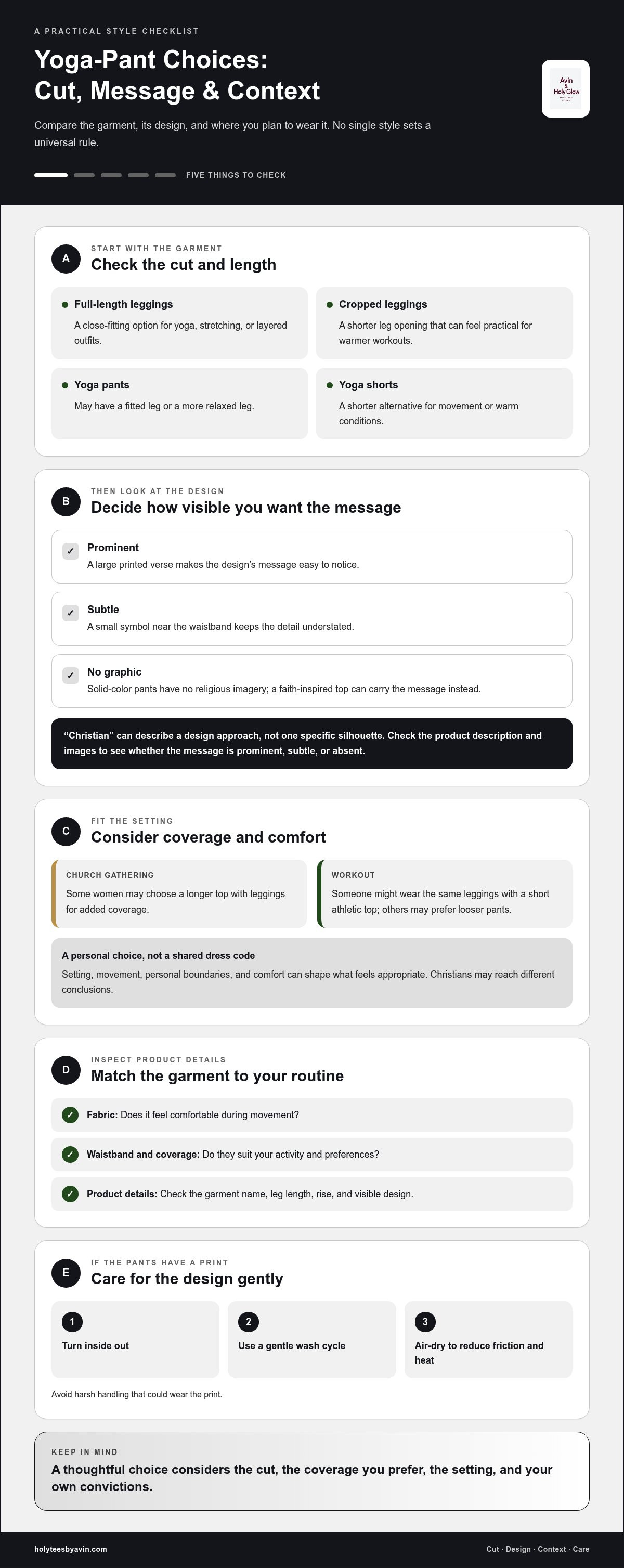
Context can influence how someone feels about wearing fitted pants. A woman might choose a longer top for a church gathering but wear the same leggings with a short athletic top for a workout. Others may prefer looser workout pants in either setting. Such choices can reflect comfort, movement, personal boundaries, and consideration for others. They don’t establish a shared Christian dress code.
What fabrics and features should I look for in Christian yoga pants? Choose fabric that feels comfortable during movement, with a waistband and coverage suited to your activity and preferences. For printed pants, consider whether the design matches how you want to express your faith.
Care matters, especially when a garment has a printed design. How should I wash and care for printed Christian yoga pants? Turn them inside out, use a gentle wash cycle, and avoid harsh handling that could wear the print. Air-drying can reduce the friction and heat of machine drying.
Masonheimer also describes waiting until she was 24 years old to wear a V-neck T-shirt, showing how personal standards can change over time. She cites John 16:13 when discussing the Holy Spirit’s role in conviction, confirmation, comfort, and control. That reference belongs to her account of discernment, rather than serving as a clothing rule. A reader can consider her own convictions, the setting, and the practical needs of movement before deciding what feels appropriate.
A respectful discussion makes room for those differences. James 1:19 offers a useful reminder to listen before judging someone else’s clothing choice. Modesty can guide a personal decision without becoming a tool for shaming others. For some women, fitted pants feel comfortable and suitable; for others, added coverage better reflects their boundaries. The decision is shaped by more than the garment alone.
Her discussion of modesty for Christian women is framed around a biblical worldview and Scripture. In her account, the concern rests on the principle behind a clothing choice, rather than yoga pants themselves. The focus is on the reasoning behind the decision.
What Christian yoga pants brands and styles are available?
Faith can shape a garment’s message while its cut serves movement. Christian apparel brands may use crosses, Scripture references, or understated faith-inspired details. Other activewear labels offer plain leggings without religious graphics. The distinction is often the design’s message, not a different fabric or fit. Compare what the brand communicates with the coverage and style you want.
Some labels make faith visible through a large printed verse, while others use a small symbol near the waistband. Another option is a solid-color pair with no religious imagery. These examples show why “Christian” can describe a design approach rather than one specific silhouette. Read the product description and examine garment images to see whether the message is prominent, subtle, or absent.
Styles can also differ by cut and intended use. Common examples include:
- Full-length leggings: A close-fitting option for yoga, stretching, or layered outfits.
- Cropped leggings: A shorter leg opening that can feel practical for warmer workouts.
- Yoga pants: A familiar activewear category that may have a fitted or more relaxed leg.
- Yoga shorts: A shorter alternative for movement or warm conditions.
- Printed designs: Styles that feature a cross, a short Scripture phrase, or another faith-related graphic.
These examples describe garment types, not a promise that every Christian clothing brand carries each one. Some retailers focus on graphic apparel, while others offer simple workout basics. Use product filters and descriptions to narrow your options. Check the garment name, leg length, rise, and visible design before deciding whether a style suits your routine.
Brand identity can guide your search, but it shouldn’t replace a close look at the garment. One label might emphasize bold Christian streetwear, while another keeps its faith references minimal. Check whether a graphic sits on the front, leg, or waistband. If you prefer a quieter look, a plain pair with a faith-inspired top can express your style without a prominent pants graphic.
Consider the whole outfit, too. Full-length leggings can pair with a longer top when you want added coverage; cropped leggings may work with a loose T-shirt for a class or walk. A printed pair can make its message the outfit’s focal point, while solid colors leave more room for a graphic hoodie or shirt. The right style depends on where you plan to wear it and how you want your faith expressed.
Compare the design, cut, and product details together before choosing. A cross print won’t tell you how the waistband fits, and a familiar brand name won’t reveal the coverage you prefer. Assess each listing as an individual garment, then select the style that suits your activity and taste.
What Bible verses or Christian designs appear on yoga pants?
Christian designs can communicate faith through words, symbols, or a quiet visual detail. A pair might feature a cross, a short Scripture reference, or a phrase such as “Walk by faith.” Others use a small emblem near the ankle instead of a large graphic. These are possible design approaches, not a guarantee that every retailer carries them.
Scripture can appear as a full quotation, a shortened phrase, or a book-and-verse reference. James 1:19, for example, is associated with being quick to hear, slow to speak, and slow to anger. A design might print the reference alone, letting the wearer recall the passage without placing the full wording across the garment. John 16:13 is another reference discussed in Christian writing about the Holy Spirit’s guidance.
Common visual motifs can carry different meanings for different wearers. A cross is a direct Christian symbol; a dove may suggest peace or the Holy Spirit; and a simple fish outline can reference Christian tradition. Some designs pair a symbol with a brief phrase, while others rely on lettering alone. Placement changes the look: a small ankle mark feels discreet, while a large thigh print becomes a focal point.
Consider these design formats when comparing options:
- Verse reference: A citation such as James 1:19 keeps the message concise.
- Short Scripture phrase: A few words can make a passage recognizable without printing its full text.
- Faith statement: Words such as “Faith” or “Hope” communicate a theme without a verse citation.
- Symbol only: A cross or dove offers visual expression without lettering.
- Minimal detail: A small mark near the hem suits someone who prefers subtle graphics.
Read the wording carefully before choosing. A reference can point to different translations, and a short phrase may not reproduce the surrounding passage. If the exact wording matters to you, compare the printed text with the Bible translation you use. For example, James 1:19 may appear as a reference only, rather than as a complete quotation.
Design also affects how easily the pants coordinate with other clothes. A black pair with a small cross can work with a plain top, while bold lettering may pair best with a simple shirt. Check whether the graphic sits across a high-stretch area, such as the knee or hip, because movement can change how lettering looks. A symbol near the lower leg may remain visually distinct through common yoga poses.
Choose a design that reflects your beliefs and feels right for the setting. A verse reference can serve as a personal reminder; a visible phrase can make faith part of an outfit’s public expression. For a restrained look, choose a small symbol. For a more expressive style, look for clear lettering and a graphic whose message you understand.
Are Christian yoga pants available in plus sizes and different lengths?
Yes, some Christian activewear ranges include plus sizes and different leg lengths, though options vary by brand and style. A faith-inspired print doesn’t determine the sizing range. Check each garment’s size chart and length description, since one label’s “short” or “tall” may differ from another’s. A solid-color pair and a printed pair from the same retailer may also come in different size options.
Use your measurements to compare with the chart. Waist and hip measurements help identify a likely size, while inseam helps assess where the hem may fall. If full-length leggings often bunch at your ankles, compare your inseam with the garment’s listed length. If cropped leggings usually finish higher than you prefer, look for a longer cut rather than sizing up.
Plus-size fit involves more than the number on a label. Consider how the waistband sits, whether the garment offers the coverage you want, and how the legs feel during movement. A waistband that rolls during a forward fold may distract from your practice; fabric pulling across the hips may mean a different cut or size feels better. The product’s size chart is a stronger guide than assuming every brand fits alike.
Length names can help narrow choices, but read how each listing describes them. Common terms include:
- Full length: A longer leg intended to reach toward the ankle.
- Cropped: A shorter leg that finishes above the ankle.
- Capri: A cut ending around the lower leg, with the exact hem depending on the wearer.
- Petite or short: Labels that may indicate a shorter inseam or proportion.
- Tall or long: Labels that may indicate extra length for a longer leg.
Length names aren’t identical across brands. Compare the stated inseam, model height, and garment size when those details appear together. A model wearing a medium-length legging may provide a useful visual reference, but your own inseam is more relevant. Review the return and exchange terms before purchasing if you’re choosing between two cuts.
Faith graphics can affect where you focus when assessing fit. A cross printed near the calf may sit differently on a shorter leg than it does in product photos. Scripture lettering across the thigh may stretch when the garment is worn. Examine images and descriptions, then consider whether the design placement works for your height and preferred coverage.
For a practical comparison, note your waist, hip, and inseam measurements, then match each one to the brand’s chart. Check the waistband and hem in the garment description, and compare the cut with leggings you already find comfortable. This helps you choose Christian activewear for your body and routine, rather than relying on a size label alone.
How do Christian yoga pants compare with regular yoga pants for fit and quality
Christian and regular yoga pants can serve the same basic purpose: comfortable movement during yoga, stretching, or workouts. The clearest difference is often the design, such as a cross, Scripture reference, or faith statement. A Christian message doesn’t establish how a garment fits or how well it’s made. Compare individual product details rather than assuming the label guarantees a certain cut or quality.
Fit depends on the garment’s pattern and the wearer’s preferences. Two pairs in the same size may sit differently at the waist or hips. Check the size chart and look for measurements, rise, and leg length. Consider whether the waistband stays comfortable during a seated pose and whether the legs feel restrictive in a lunge. These practical checks matter for faith-printed and plain leggings alike.
Judge quality by garment details, not the message printed on the fabric. Product descriptions may identify material, seams, waistband construction, or print placement. If a pair has lettering across the knee, inspect that area in the product images. A printed design can distinguish a garment, but it doesn’t by itself show how the fabric feels or how the seams are finished.
Compare listings using these useful checks:
- Material details: Read the fabric description and consider whether it suits your planned activity.
- Construction: Look for close images of seams, waistband, and hems.
- Fit information: Compare the size chart with your measurements and familiar garments.
- Print placement: Check whether words or symbols cross areas that bend or stretch.
- Care guidance: Follow the garment’s label to help preserve both fabric and design.
Regular yoga pants may be plain, patterned, or branded, while Christian styles may add faith-related graphics. Neither category automatically fits better. A plain pair with a wide waistband might suit one person, while a faith-designed pair with a different cut may suit another. Stated measurements and construction offer more useful comparisons than the category name.
Try familiar movements when assessing fit: bend your knees, reach overhead, and sit cross-legged. Notice whether the waistband shifts, fabric pulls, or a printed phrase distorts. If you’re comparing two listings, use the same checks for both. This keeps your decision focused on comfort and construction, rather than treating Christian artwork as proof of superior quality.
If faith-forward design is part of your search, explore Christian yoga pants and compare their listed details with your fit preferences.
Separate evidence about the garment from background about someone discussing faith or clothing. A biography can provide context, but it doesn’t establish a pair’s measurements, fabric feel, seam finish, or performance in movement. Base your comparison on the item’s description and how it feels in use, and treat faith-related graphics as a design preference rather than a fit specification. Consider whether the garment suits your expected movements, and use its care guidance to judge whether the design and material are practical for you.
Phylicia Masonheimer’s author biography states that she was graduating with a bachelor’s degree in Religion through Liberty University in May 2015. That biographical detail does not determine the fit or quality of any particular pair of yoga pants.
Avin & Holy Glow: Single Pan Blush
Avin & Holy Glow offers Single Pan Blush for readers who want to extend intentional style from activewear to makeup. After considering how faith, comfort, and personal expression shape what you wear, blush offers another way to create a look that feels like your own. The range also includes a Hydrating Facial Cleanser, lipsticks, and lip gloss, so you can explore beauty options alongside your clothing choices.
Choose makeup according to the look you want, whether that means a touch of blush or pairing it with lip color. Avin & Holy Glow offers options to consider as part of your everyday routine.
Visit holyteesbyavin.com to explore Avin & Holy Glow.
Choose What Feels True to You
Let your next clothing choice begin with your own values, not pressure to meet someone else’s standard. Christian yoga pants can express faith through design, while your comfort and convictions help determine what feels right for you. Carry that same intention into the rest of your everyday style.
Avin & Holy Glow offers Single Pan Blush, Hydrating Facial Cleanser, and lipsticks for readers exploring beauty alongside faith-inspired style. These options can complement your personal choices about Christian yoga pants and your wider routine.
Explore Avin & Holy Glow and find a thoughtful next step for your style. Wear what supports your comfort and convictions with confidence.
Frequently Asked Questions
What are Christian yoga pants?
Christian yoga pants are workout leggings with faith-inspired details, such as a cross, a Scripture reference, or a short message. If you’re choosing Christian yoga pants for class, consider whether you want the design visible during movement or subtle beneath a longer top. The label describes an expressive style, so inspect the garment’s specific design and details to decide whether it suits your routine.

Article by
Avin
Avin is the founder and visionary behind Avin & Holy Glow, a Black woman-owned Brooklyn brand that uniquely bridges the worlds of expressive streetwear and ethical beauty. Driven by a mission to offer premium style without compromising on values, Avin curated a collection that features quality activewear, hoodies, and graphic tees paired alongside a dedicated line of vegan and cruelty-free cosmetics. Through her platform, she champions mindful living, creating high-performance skincare and beauty products that celebrate clean ingredients and sacred self-care.