
What if dependable coverage didn’t have to mean a heavy, mask-like layer? It’s understandable to want a foundation that softens the look of uneven tone or visible marks without hiding the skin you feel like yourself in. Full cover foundations offer more coverage, but the result also depends on your shade, finish, and how much you apply.
This guide explains what full coverage can and can’t do, how to compare skin depth and undertone, and how to choose a finish that suits the look you want. You’ll also learn how to apply foundation gradually, so you can add coverage where you want it instead of starting with a thick layer everywhere.
We’ll cover practical ways to assess formula, shade, and application, including how to reduce the chance of foundation emphasizing texture. Avin & Holy Glow offers foundations, including full cover foundations. Use the guidance ahead to decide what you want from coverage and make a choice that feels comfortable and still like you.
Key Takeaways
- Separate coverage level from formula and finish to clarify what you want foundation to do.
- Compare liquid, cream, and powder formats, then consider matte, natural, and radiant finishes.
- With full cover foundations, assess skin depth and undertone separately for a more cohesive shade match.
- Build coverage in thin layers, adding more only where you want it.
- Explore Holy Tees by Avin’s foundation category, which includes full cover foundations.
What Are Full Cover Foundations, and What Can They Cover?
Coverage describes how much visible skin a foundation can obscure. Full cover foundations are designed to provide more coverage than sheer or medium options. Formula describes the product’s form, while finish describes its appearance on the skin. These are separate qualities: a foundation can offer fuller coverage without being a particular format or finish.
Foundation can soften the appearance of uneven tone, redness, or blemishes. It doesn’t change the skin itself, and the result depends on the product and how you apply it. The Foundation (cosmetics) overview offers broader background on foundation types and uses. Your own result depends on the formula, the amount applied, and how it sits on your skin.
Think of coverage as a range, not an all-or-nothing promise. Foundation may reduce the contrast in some areas while natural skin remains visible elsewhere. Texture, discoloration, and other features can still show through. A useful starting point is to decide what you want to soften, rather than expecting foundation to erase every detail.
Application changes the result, too. A small amount spread evenly can look very different from a thick layer applied all at once. Fuller coverage gives you more pigment to work with, but you don’t have to use the maximum amount across your entire face. Place product where you want it, then assess before adding more.
How Is Full Coverage Different From Medium Coverage?
Medium coverage generally lets more natural skin show through, while full coverage is intended to obscure more visible tone and marks. These labels aren’t universal measurements, though, and the same term can look different across brands and formulas. Apply a thin layer first and assess it as you go. One heavy layer can look more noticeable, especially in areas that need little coverage.
Does Full Coverage Always Look Heavy?
No. Coverage level alone doesn’t determine whether foundation looks heavy. Shade match, finish, skin preparation, and application all affect the final appearance. Start with a light layer and check it in natural light before adding more to specific areas. This keeps the result adjustable, although no formula or method suits everyone or conceals every concern.
How Formula and Finish Shape a Full Coverage Foundation
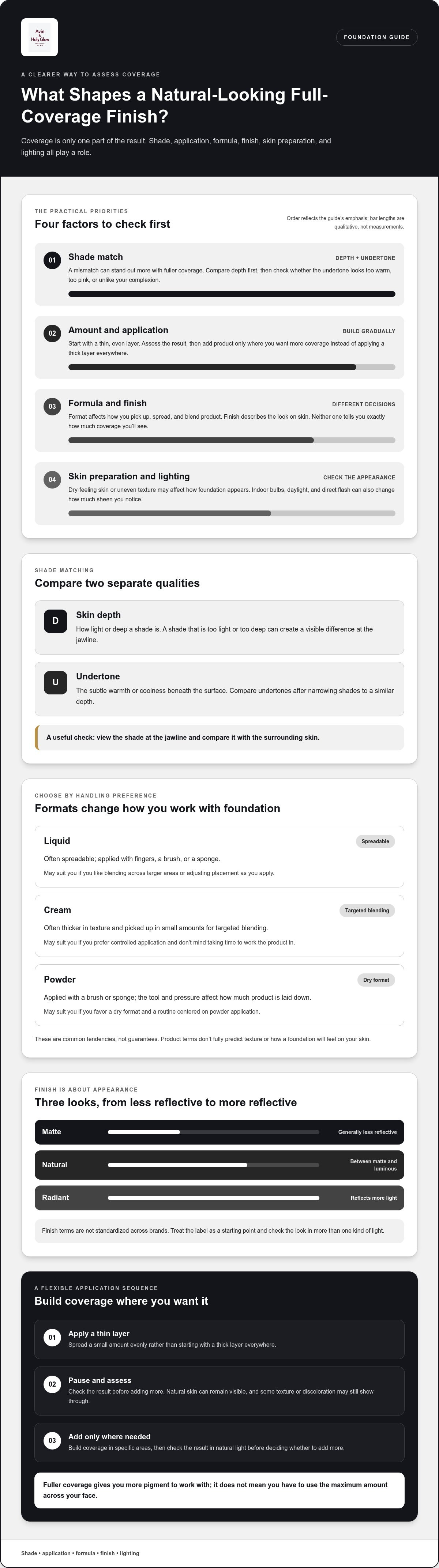
Formula and finish describe different parts of the experience. Formula is the product’s format and affects how you pick it up, spread it, and blend it. Finish is the look it leaves on the skin. Neither tells you exactly how much coverage you’ll see, and product terms can vary between brands. Treat labels as a starting point, then consider the feel and appearance you prefer.
Here’s a general guide to three common formats. These are typical tendencies, not guarantees about every foundation.
| Format | Common handling | May suit your routine if |
|---|---|---|
| Liquid | Often spreadable, applied with fingers, a brush, or a sponge. | You like blending across larger areas or adjusting placement as you apply. |
| Cream | Often thicker in texture and picked up in small amounts for targeted blending. | You prefer controlled application and don’t mind taking time to work the product in. |
| Powder | Applied with a brush or sponge; the tool and pressure affect how much product is laid down. | You favor a dry format and a routine centered on powder application. |
Which Foundation Formula Fits Your Routine?
Consider the pace and tools you enjoy using. If you prefer blending with your fingers, a format that spreads easily may feel intuitive. If you like working in small areas with a brush or sponge, choose a formula that gives you that control. Think about your usual routine, too. A product that fits your habits is more practical than one that requires steps or tools you rarely use.
Terms such as “liquid,” “cream,” or “powder” are useful clues, but they don’t fully predict texture or how a product will feel on your skin. When applying foundation, notice whether you can distribute it comfortably and reach your preferred coverage without rushing.
What Does Foundation Finish Change?
Finish describes surface appearance, not coverage by itself. A matte finish generally looks less reflective; a natural finish sits between noticeably matte and luminous; a radiant finish reflects more light. These terms aren’t standardized, so one brand’s description may not look identical to another’s. Choose based on the look you want, rather than the label alone.
Skin preparation can influence how foundation appears. Dry-feeling skin or uneven texture may affect how product looks in certain areas. Lighting matters, too: indoor bulbs, daylight, and direct flash can change how much sheen you notice. Check your makeup in more than one light before deciding whether the finish feels right.
For full cover foundations, focus on the combination that suits you: a workable format, a finish you enjoy, and an application routine you can repeat comfortably. Explore full cover foundations as you consider the coverage, feel, and look you prefer.
How to Choose a Shade That Keeps Full Coverage Looking Natural
A shade mismatch can be more noticeable with fuller coverage because less natural skin shows through to blend the colour. Consider two things separately: skin depth, how light or deep a shade is, and undertone, the subtle warmth or coolness beneath the surface. Getting both into the right range helps foundation look cohesive across your face and surrounding skin.
First, narrow down shades that seem close in depth, then compare undertones. A shade that is too light or deep can create a visible difference at the jawline. If the depth seems right but the undertone is off, the colour may look too warm, too pink, or unlike your complexion. Judge a shade by how it appears against your skin, not by its name.
How Can You Identify Your Undertone?
Warm, cool, and neutral are useful comparison terms, not strict categories you have to fit. Warm shades tend to look more golden or peachy, cool shades more pink or rosy, and neutral shades sit between those impressions. When comparing shades, look at how a small amount along your lower cheek and jawline sits beside your neck in natural light. A close match should blend into the face and look harmonious beside the neck.
Vein colour and jewellery preferences can offer clues, but they aren’t definitive tests. Veins may appear blue, green, or a mix, and lighting or skin depth can affect what you see. Liking gold or silver jewellery doesn’t determine your undertone either. Use those hints to guide your comparisons, then trust how the shades look against your skin.
How Can You Avoid a Mask-Like Finish?
Use your face and the skin around it as your reference, rather than relying on a hand swatch. Hands can differ in colour from the face, so a match there may look disconnected once applied. Compare a small amount along the jawline and check the result in daylight. Look for a shade that transitions smoothly instead of leaving a distinct edge.
Apply less product at first, then build only where you want more coverage. Even a close shade match can look obvious if too much is spread uniformly over the face. Check the overall balance beside your neck and around the hairline. If the colour looks like a layer sitting apart from your skin, adjust the amount or placement.
Choose with your preferred appearance in mind, rather than making assumptions about what a particular skin type should wear. If you’re comparing fuller coverage with a lighter makeup option, BB cream is another category to consider. Full cover foundations can suit different preferences, but shade, amount, and finish all shape the result.
How to Apply Full Cover Foundation in Thin, Even Layers
A controlled application gives you more say over where coverage sits and how much skin remains visible. Begin with a small amount, blend it well, then decide whether you want more. This helps prevent excess product from collecting in areas that didn’t need much coverage.
Tools are a matter of preference. Clean fingers, a makeup sponge, or a foundation brush can all help distribute foundation. Use the method that feels easiest to control, work in small sections, and blend the edges toward your hairline and down along your jaw to avoid a sharp separation between face and neck.
What Is a Simple Application Order?
Keep the routine flexible. Primer and finishing products are optional, not requirements. If you use skincare to prepare your skin, let it settle before applying foundation so you have a comfortable, even base. A serum can be part of that preparation, with its place depending on the other skincare products in your routine.
- Start with clean skin. Apply your usual skincare and give it time to settle. If your skin feels slick or damp, pause before adding makeup.
- Add primer if you prefer. Use it only if it suits your routine. Smooth a small amount over the areas where you want it, following the product directions.
- Place a little foundation. Start where you want the most coverage, such as around the nose or over areas of uneven tone. Use a small amount rather than coating the whole face at once.
- Blend outward. Work across the face with light, even strokes or taps. Feather the application at the jawline and hairline to soften visible edges.
- Assess before adding more. Look at the result in good light. Add another thin layer only to areas where you still want coverage.
- Finish only if you choose. Continue with other makeup or a setting product if it fits your desired look. Neither step is essential for every routine.
How Can You Build Coverage Without Applying Too Much?
Think about placement first. Dot a small amount onto the areas you want to cover, then blend until the layer looks even. Pause before reaching for more. Once the first layer is distributed, you can see what still needs attention and add a little there instead of repeating the same amount across your face.
Use a lighter touch around areas where product tends to collect, such as the creases beside the nose. If the foundation starts to look thick, stop adding product and gently blend the edge. Full cover foundations don’t need to be applied heavily everywhere to create a more covered look.
Keep skincare layering comfortable and straightforward so makeup can sit as you prefer. For beauty products to complement your routine, explore Holy Tees by Avin beauty products.
Finding Full Cover Foundations at Avin & Holy Glow
Choosing foundation is personal, shaped by the coverage you want and the look and routine that feel right to you. Holy Tees by Avin offers foundations, including full cover foundations. Use the criteria in this guide to narrow down what matters most, and base your decision on the details provided for the product you’re considering.
What Should You Consider Before Choosing a Foundation?
Pause for a quick check-in before choosing. Do you want more coverage across your face or only in certain areas? Which finish do you prefer? Does the shade look harmonious with your face and surrounding skin? Will the formula fit the way you like to apply makeup? Answering these questions can keep your decision focused on the qualities you value, rather than a label alone.
Read product descriptions for the details they provide. A category name can indicate the type of coverage, but it doesn’t by itself establish a product’s shade range, finish, ingredients, or suitability for a particular skin type. Use the stated information to guide your decision and keep your preferences in view. A match between what you want and what the description says is more useful than assuming every foundation offers the same experience.
Think about the rest of your makeup routine, too. If you plan to add colour to your cheeks, blush can complement foundation without changing your coverage choice. A Single Pan Blush is a related complexion product to explore as you consider how makeup products work together. Keep the focus on the overall effect you want, whether that means a more defined cheek or a softly balanced look.
Where Can You Explore Avin & Holy Glow Foundations?
Once you’ve identified your priorities, explore the foundation category at Holy Tees by Avin. The brand offers foundations, including full cover foundations, for those considering fuller coverage. Use the product information to guide your selection, and avoid assuming that all formulas share the same finish, ingredients, or wear.
Let your coverage preference, shade considerations, and application habits lead the way. When you’re ready to browse the beauty range, explore Holy Tees by Avin.
Make Your Next Makeup Choice with Confidence
Your foundation routine can be intentional without feeling fixed. Let your preferences guide what you try, and adjust how much coverage you wear from one day to the next. Full cover foundations are one option, not a rule for how your makeup should look. Choose what supports the appearance you want and feels comfortable in your routine.
As you explore, read product descriptions carefully and focus on details that matter to you. A considered choice can bring clarity to your makeup bag, whether you’re refining a familiar look or trying a different approach. Let curiosity lead, and make the experience your own.
Ready to find a foundation that fits your coverage preferences? Explore Holy Tees by Avin’s beauty range and choose the look that feels like you.
Frequently Asked Questions
What does full coverage foundation mean?
Full coverage foundation is designed to make more of the skin’s visible tone and marks less noticeable than lighter-coverage makeup. It doesn’t mean every feature disappears or that the product must be spread thickly over the whole face. You might want fuller coverage over areas of discoloration while keeping other parts of your complexion more visible. Your result depends on the formula and how you use it.
Can full coverage foundation look natural?
Yes, fuller coverage can still suit a natural-looking makeup style. Consider the overall effect you want, then check your application in ordinary daylight and at a conversational distance, not only close to a mirror. Natural-looking makeup doesn’t have to mean invisible foundation. It can mean the colour and placement feel harmonious with the rest of your look. You can also keep eye and lip makeup understated for a softer impression.
How do I choose a full coverage foundation shade?
Consider both your skin’s depth and undertone, then compare how the colour looks against your face. When assessing a shade, use a small swatch and give it a little time to settle before deciding. Check it in daylight if possible. For online shade descriptions, use the details provided as a guide, while remembering that screens can display colours differently.
Is full coverage foundation suitable for everyday makeup?
It can be part of an everyday routine if you enjoy the look and feel of wearing it. You don’t have to use the same amount every day. You might apply it selectively for errands, then choose broader coverage for a polished work or evening look. Let your schedule and preference guide the amount. If makeup feels uncomfortable or doesn’t suit the look you want that day, choose another approach.
What is the difference between full coverage and medium coverage foundation?
Medium coverage generally leaves more of your natural complexion visible, while full coverage is intended to obscure more. The distinction can help you decide how much of your skin you want showing for a particular look. Labels aren’t consistent measurements across brands, so compare the stated coverage and your own experience rather than assuming two foundations with the same label will look identical.
How do I apply full coverage foundation without it looking cakey?
Use a clean tool or clean fingers, and work in small sections instead of spreading a large amount across your face at once. Avoid adding product repeatedly to an area that already looks even. If makeup gathers in a crease, gently blend the edge instead of covering it with another layer. Aim for an even application that feels intentional, not for every part of your face to look identical.
Can I build full coverage foundation in layers?
Yes. Start with a light pass, then look at the areas where you still want more coverage. Add a small amount only to those spots and blend the edges into the surrounding makeup. This targeted approach can give you more control than applying another layer across your whole face. How easily a foundation builds depends on its formula.

Article by
Avin
Avin is the founder and visionary behind Avin & Holy Glow, a Black woman-owned Brooklyn brand that uniquely bridges the worlds of expressive streetwear and ethical beauty. Driven by a mission to offer premium style without compromising on values, Avin curated a collection that features quality activewear, hoodies, and graphic tees paired alongside a dedicated line of vegan and cruelty-free cosmetics. Through her platform, she champions mindful living, creating high-performance skincare and beauty products that celebrate clean ingredients and sacred self-care.