
If you’re searching for a Natural Plant-based Face Cleanser Oil-Free Dry Skin option, an oil-free formula may still suit your routine, but its label can’t predict how your skin will feel after rinsing. Dryness, flaking, and that uncomfortable just-washed feeling are reasons to look beyond a single claim and assess the formula, directions, and your own response.
Plant-based describes ingredient origins, while oil-free describes what a formula leaves out. Neither phrase guarantees a gentle cleanse. This guide explains how to read cleanser labels, compare options, notice signs of discomfort, and use a practical checklist to choose with comfort in mind. Avin & Holy Glow offers a Hydrating Facial Cleanser and a Kale Facial Cleanser. Compare their product information with your preferences rather than assuming ingredients or skin benefits from their names alone.
Key Takeaways
- Oil-free and plant-based describe different aspects of a cleanser. Neither label alone guarantees a gentle, non-drying formula.
- When assessing a Natural Plant-based Face Cleanser Oil-Free Dry Skin option, consider the full ingredient list and how your skin feels after rinsing.
- Compare cleanser formats and label details, but don’t assume a product category predicts how it will feel on your skin.
- Use a practical checklist: consider your skin’s needs, read the label, follow product directions, patch test, and pay attention to comfort.
- Holy Tees by Avin offers a Hydrating Facial Cleanser and a Kale Facial Cleanser to consider as you compare options.
What Does 'Oil-Free, Plant-Based Face Cleanser' Mean for Dry Skin?
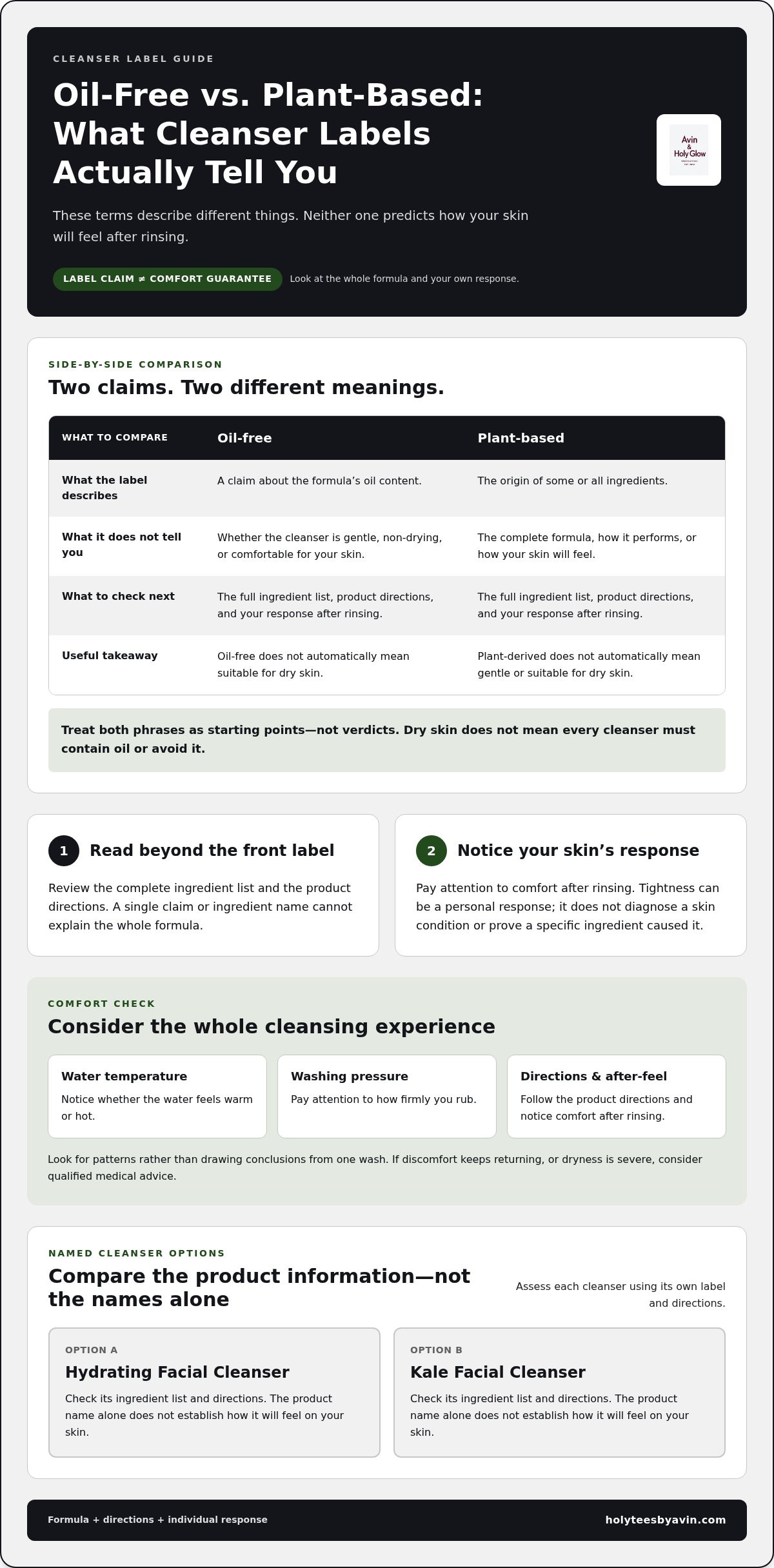
These label terms describe different things. “Oil-free” is a claim about a formula’s oil content; “plant-based” points to the origin of some or all ingredients. Neither tells you, by itself, how effectively a cleanser removes residue or how your skin will feel afterward. Dry skin describes a skin condition, not a rule that every cleanser must contain oil or avoid it.
That distinction matters when you’re considering a Natural Plant-based Face Cleanser Oil-Free Dry Skin option. Treat the label as a starting point. The full formula, product directions, and your own response offer more useful clues than a single phrase on the front of the bottle.
Does oil-free automatically suit dry skin?
No. Oil-free doesn’t automatically mean gentle, non-drying, or non-comedogenic. It indicates that the product is presented as formulated without oils, but that claim doesn’t reveal everything about its cleansing ingredients or how it will feel on your skin.
Removing oils from a formula is not the same as cleansing gently. A product’s overall composition and the way you use it both matter. One person may prefer an oil-free cleanser; another may find a different texture more comfortable. Oils aren’t universally necessary for dry skin, and their presence alone doesn’t establish that a cleanser will suit you. Notice whether your skin feels comfortable after washing instead of treating the oil-free label as a guarantee.
What does plant-based mean on a cleanser label?
Plant-based or plant-derived generally describes ingredient origin. It doesn’t establish that every ingredient comes from plants, and it isn’t a universal standard for gentleness, safety, or results. An ingredient may come from a botanical source and still perform differently depending on how it’s used in the finished formula.
Plant-based describes where ingredients come from; the complete formula determines how the cleanser performs. A botanical name on the front label doesn’t explain the cleanser’s full composition or predict whether your dry skin will feel comfortable after rinsing.
Read the ingredient list rather than relying on one prominent claim. Look at the formula as a whole, including its cleansing ingredients and other components named on the label. Consider the product directions too, since using a cleanser differently from its instructions may affect your experience. “Natural” is another broad claim, so don’t assume it gives a complete account of a product’s ingredients or suitability.
Use labels as starting points, not verdicts. Identify what matters to you, review the package information, and pay attention to your skin’s response during and after cleansing. A label can describe a formula’s ingredients or claims; comfort is something you assess in use.
How Dry Skin Responds to Cleansing: Barrier, Surfactants and Comfort
Your skin has a protective outer layer that helps hold moisture in and shield the surface from everyday irritants. Its outermost part, the stratum corneum, is made up of skin cells and lipids. Think of it as a flexible protective covering, not an impermeable wall. Cleansing helps lift away soil, excess oil, makeup, and other residue, but how your skin feels afterward can depend on the formula and the way you use it.
That’s why choosing a Natural Plant-based Face Cleanser Oil-Free Dry Skin option involves more than reading a label. Healthline offers further context on protecting and restoring the skin barrier, including how harsh cleansing may affect it. A cleanser’s ingredients, your routine, and your individual response all matter. No single label tells the whole story.
Why can dry skin feel tight after washing?
Tightness after washing can be a personal response, but it doesn’t diagnose a skin condition or prove that a specific ingredient caused it. Water temperature, how often you cleanse, and how firmly you rub are practical factors to notice. Observe whether comfort changes when you use less rubbing or follow the product directions closely. Track how your skin feels after cleansing instead of judging the experience by front-label claims alone.
What should readers know about surfactants?
Surfactants are cleansing ingredients that help loosen and lift soil, residue, and excess oil so they can be rinsed away. They aren’t all interchangeable, and the word itself doesn’t tell you whether a finished cleanser will feel comfortable on your skin. Read the complete ingredient list and follow the product’s directions rather than making a decision based on one ingredient name or label claim.
The formula’s cleansing ingredients, your routine, and your individual skin response work together to shape how your skin feels after washing. Assess that experience by looking for patterns, not by drawing conclusions from one wash. Consider what else changed in your routine, such as warmer water or more rubbing, and avoid assuming a single cause.
- Notice whether your skin feels comfortable after rinsing or feels tight.
- Pay attention to water temperature and how much pressure you use while washing.
- Follow the product directions, and note whether discomfort keeps returning.
Gentle handling matters, but persistent irritation or severe dryness deserves more than trial and error. Consider seeking qualified medical advice if symptoms continue or feel severe. For a practical cleanser comparison, explore Holy Tees by Avin facial cleansers and assess each product using its own label and directions.
Oil-Free vs. Other Cleansers: How to Compare Options for Dry Skin
Comparing cleansers is easier when you separate three things: what a formula claims, what format it comes in, and what the label actually tells you. Oil-free does not automatically mean drying, and it doesn’t automatically mean hydrating either. A cleanser without oils may suit one person, while someone else may prefer a different formula. Neither preference can be decided from the claim alone.
Use this table as a reading guide, not a ranking. Product categories can suggest what to investigate, but they can’t establish how a cleanser will feel on your skin.
| What to compare | What it may tell you | What it can’t tell you alone |
|---|---|---|
| Oil-free wording | The product makes a claim about oils in its formula. | Whether it will feel drying, hydrating, or comfortable for you. |
| Cleansing format | The product may be described as a gel, cream, foam, or another format. | Whether that category will suit your skin or cleanse gently. |
| Fragrance statement | If the label says “fragrance-free” or lists fragrance, it gives a specific detail to consider. | How your skin will respond. Don’t assume a fragrance claim unless it appears on the label. |
| Ingredient list and directions | These provide details about the formula and how the product is intended to be used. | A guaranteed result for every person. |
Which cleanser details matter more than one front-label claim?
Start with the complete ingredient list, the product’s stated purpose, and its directions. Those are more useful for comparison than broad front-label words such as “natural” or “gentle,” which don’t explain every aspect of the finished formula. Check fragrance wording only as it appears on the actual package. A plant-derived ingredient doesn’t guarantee a particular skin response, so treat claims as clues, then evaluate the product in use.
For example, if two cleansers both say “oil-free,” compare their ingredient lists and directions rather than assuming they’re interchangeable. If one label includes a fragrance statement and the other doesn’t, record that as a difference, not proof that one will feel better. Keep the comparison grounded in details you can verify.
Is a natural cleanser always gentler?
No. Ingredient origin alone doesn’t determine whether a cleanser will irritate you or feel comfortable. Plant-derived and synthetic ingredients shouldn’t be treated as automatic opposites or as a simple measure of safety. If you know you’re sensitive to a particular ingredient, use that knowledge when reading labels. Stop using a product that causes irritation, and seek qualified advice if symptoms persist.
Choose based on evidence you can observe: label details, directions, and your own experience. If you’re comparing a Natural Plant-based Face Cleanser Oil-Free Dry Skin option, don’t let one appealing phrase make the decision for you. Explore Holy Tees by Avin facial cleanser options with the same careful label-reading approach, then assess each formula using its own information.
How to Choose and Use a Plant-Based Cleanser for Dry Skin
A reliable routine starts with your own needs, not a one-size-fits-all rule. Use this checklist to assess a cleanser thoughtfully, then give your skin’s response more weight than a front-label promise. The aim is a comfortable cleanse, not a complicated routine.
A five-step label and skin-comfort checklist
- Identify your needs. Note whether your skin often feels dry, tight, or easily irritated, and consider any ingredients you already know don’t agree with you. Dry skin varies, so a formula that suits one person may not suit another.
- Read the full label. Review the complete ingredient list and any statements about ingredient origin. Plant-derived describes where ingredients come from; it doesn’t predict how the finished cleanser will feel or perform on your skin.
- Follow the directions. Use the cleanser as its packaging instructs. Don’t assume every product should be used the same way or at the same frequency. Keep the rest of your routine steady while you assess how the cleanser feels.
- Patch test thoughtfully. If you’re concerned about a reaction, follow the product’s patch-testing directions, if provided. A small-area test can be a cautious first step, but it can’t guarantee that a product won’t irritate your skin later.
- Pay attention to comfort. Notice how your skin feels during washing and after rinsing. If irritation occurs, stop using the product. Seek professional guidance if symptoms persist, become severe, or concern you.
Where does cleanser fit in a simple routine?
Keep cleansing as one purposeful step. Wet your face with lukewarm water, apply the product as directed, and use gentle hands rather than scrubbing. Rinse as instructed and pat your skin dry instead of rubbing briskly. These small choices can make your routine feel more considered, without assuming that any cleanser guarantees a particular result.
What follows is up to you. Some routines include a serum or moisturizer after cleansing; others stay simple. Additional products are optional, and you don’t need to add them just because a routine guide suggests a particular order. If you choose a serum, use its own directions and consider whether it fits your preferences and skin needs.
A Natural Plant-based Face Cleanser Oil-Free Dry Skin routine should be guided by the product’s directions and your comfort, not by a universal cleansing schedule. The Hydrating Facial Cleanser is one option to compare. Use the same label-reading checklist to assess it, and don’t rely on its name alone to determine its ingredients or how it will feel on your skin.
Explore Avin & Holy Glow Facial Cleansers with a Clearer Framework
Product names can suggest a purpose, but they don’t replace the product information. Holy Tees by Avin offers a Hydrating Facial Cleanser and a Kale Facial Cleanser. Compare each cleanser’s stated purpose with its ingredient and usage information. Don’t infer oil-free, plant-based, fragrance, or dry-skin suitability claims from a name alone.
That distinction keeps your decision grounded. If you’re considering a Natural Plant-based Face Cleanser Oil-Free Dry Skin option, separate what the product actually states from what its wording might lead you to assume. Then weigh the available details against your personal sensitivities and how your skin feels after cleansing.
How to assess the available facial cleanser options
Start with the stated purpose of each cleanser, then read its ingredient information and directions. Look for details relevant to your routine and note any claims that matter to you. If a particular ingredient is a known sensitivity, take that into account. Avoid filling gaps with assumptions about ingredients, finish, fragrance, formula features, or how often to use the product.
Next, consider your own experience. After using a cleanser according to its directions, notice whether your skin feels comfortable or whether irritation occurs. That response can help you decide whether to continue using it; it isn’t a promise that the same product will feel the same for everyone. If irritation develops, discontinue use and seek professional guidance if needed.
Keep the comparison simple. Note each product’s stated purpose, the label details relevant to you, and your experience after use. This makes it easier to assess the Hydrating Facial Cleanser and Kale Facial Cleanser without treating either name as proof of a particular ingredient profile or skin benefit.
Choose with intention, not a single label
A cleanser’s label is useful when read carefully, but no single term can stand in for the full formula or your individual response. “Hydrating,” “kale,” “natural,” “plant-based,” and “oil-free” can each draw attention to a different idea. The product’s details clarify what is being claimed. Let verifiable information guide your comparison, then consider your comfort in use.
There’s no need to force a choice based on a marketing phrase or assume that one cleanser will suit every dry-skin concern. Take your time with the product information, follow the stated directions, and pay attention to what feels right for your routine. A deliberate choice is more useful than a quick decision based on one front-label claim.
Explore Holy Tees by Avin beauty products and compare the facial cleanser details with your checklist in mind.
Make Your Next Cleanser Choice with Confidence
Your routine doesn’t need to follow a trend or satisfy every claim on a label. Let it reflect what you value, what you know about your sensitivities, and what feels comfortable in everyday use. A Natural Plant-based Face Cleanser Oil-Free Dry Skin choice can be considered carefully when you treat those words as starting points for reading, not promises about how your skin will respond.
Give yourself room to make a thoughtful decision. Review the product information, follow its directions, and pay attention to your own experience rather than chasing a perfect-sounding label. If your needs change, you can reassess; skincare doesn’t have to be a fixed formula.
Ready to compare facial cleanser options? Explore Holy Tees by Avin and choose your next step with clarity.
Frequently Asked Questions
Is an oil-free face cleanser good for dry skin?
An oil-free cleanser can work for dry skin, but the claim alone can’t tell you whether it will suit your routine. If you prefer to avoid oils, compare that preference with the product directions and complete ingredient information. For a Natural Plant-based Face Cleanser Oil-Free Dry Skin choice, judge the experience after use rather than expecting the label to predict how your skin will feel.
Can a plant-based cleanser make dry skin feel tight?
Yes, it can. Plant-based ingredients don’t determine how the finished cleanser will feel, and tightness may have more than one contributing factor. Notice whether discomfort follows a particularly hot wash, vigorous rubbing, or a change in another product. If you’re trying a new cleanser, keep the rest of your routine familiar so you can better observe how your skin responds.
What does oil-free mean on a facial cleanser label?
It means the product makes a claim about oils in its formula; it isn’t a promise about how the cleanser will feel or perform. Treat the wording as a prompt to inspect the product’s full information, not as a shortcut to deciding whether it suits dry skin. If avoiding oils matters to you, use the ingredient details and directions for that specific product.
Is a natural face cleanser always gentler than a synthetic one?
No. The origin of ingredients doesn’t, by itself, establish how gentle a finished cleanser will feel for you. A plant-derived ingredient can still be a poor match for someone with a particular sensitivity, just as “synthetic” doesn’t automatically mean harsh. If you’ve reacted to a known ingredient before, check whether it appears in the product information and avoid relying on broad natural or gentle claims alone.
How should you use a face cleanser if you have dry skin?
Use it according to its own directions, with lukewarm rather than hot water and light fingertip pressure. Avoid scrubbing with a rough cloth, then rinse as instructed and pat your face dry. Don’t assume that cleansing more often will help; follow the package guidance and consider your actual needs. If your routine includes other products, add them only if they suit your preferences.
What should you look for in a plant-based cleanser for dry skin?
Look for complete ingredient information, clear directions, and product statements that address your preferences. If you know certain ingredients tend to bother your skin, use that knowledge when reviewing the label. Check fragrance claims only if they appear on the product itself. A plant-origin statement can inform your choice, but it can’t guarantee comfort, so consider your personal experience as well.
Can you use a cleanser if your skin feels irritated after washing?
If irritation starts after washing, stop using that cleanser for now rather than pushing through discomfort. Avoid introducing several new products at once, since that can make it harder to identify what may be contributing. If symptoms persist, become severe, or concern you, seek advice from a qualified healthcare professional. Restarting a product that caused irritation isn’t necessary just because its label sounds suitable for dry skin.

Article by
Avin
Avin is the founder and visionary behind Avin & Holy Glow, a Black woman-owned Brooklyn brand that uniquely bridges the worlds of expressive streetwear and ethical beauty. Driven by a mission to offer premium style without compromising on values, Avin curated a collection that features quality activewear, hoodies, and graphic tees paired alongside a dedicated line of vegan and cruelty-free cosmetics. Through her platform, she champions mindful living, creating high-performance skincare and beauty products that celebrate clean ingredients and sacred self-care.