
What if a smaller workout wardrobe gave you more outfits you actually trust? If your drawer is full but you still reach for the same few pieces, the answer isn’t necessarily another shopping trip. Learning how to build a capsule workout wardrobe 2026 starts with your real routine, not a trend list or target number of items.
Your clothes should suit the movement you do, feel right on your body, and fit the way you wash and wear them. This guide will help you decide what earns a place in your rotation, identify practical gaps, and choose additions that coordinate without compromising comfort or personal values. The goal is a manageable collection, not a prescribed bundle.
We’ll look at how workout type, fit preferences, layering needs, and laundry habits shape your choices. You’ll also see how leggings, sports bras, T-shirts, shorts, and hoodies can serve different roles, plus a simple way to consider color and faith-based activewear as part of your style.
Key Takeaways
- To learn how to build a capsule workout wardrobe 2026, start with the activities you actually do and how often you do them.
- Assess each garment for fit, comfort, coordination, and how often you’ll realistically wear it before deciding whether it belongs.
- Compare versatile basics, activity-specific pieces, and optional layers to see which roles your current wardrobe already covers.
- Use your workout schedule and laundry routine to guide how many pieces you need, rather than following a fixed item count.
- Review your capsule as your routine or fit preferences change, and follow each garment’s care label to help maintain it.
How to Build a Capsule Workout Wardrobe in 2026 Around Your Routine
A crowded drawer doesn’t always make getting dressed easier. The useful question isn’t how many workout clothes you own, but whether they serve the activities you actually do. A workout capsule is a coordinated set of clothes chosen for repeated wear across your regular workouts. For anyone figuring out how to build a capsule workout wardrobe 2026, the year is a planning context, not a reason to follow a trend or buy a fixed number of pieces.
The idea draws on the broader capsule wardrobe approach: keep a considered selection that works together. Before deciding what belongs, list your weekly activities, where you do them, whether you prefer layers, and how often laundry fits into your routine. That list gives you a practical starting point without imposing a one-size-fits-all formula.
Start with the workouts you actually do
Separate your regular activities, such as strength training, yoga, Pilates, walking, or court sports. Note whether you exercise at home, in a gym, outdoors, or on a court, since the setting can affect what feels useful. Distinguish frequent workouts from occasional ones. Give the activities that anchor your week more wardrobe space, and add options for occasional activities only when they meet a genuine need.
Include transitions, too. If you travel to a workout or prefer a layer before and after, note that. A T-shirt, hoodie, or pair of yoga pants may serve a role beyond the workout itself, while shorts or a tennis dress may suit a particular activity. These are possible roles, not a prescribed bundle.
Audit your current workout clothes before shopping
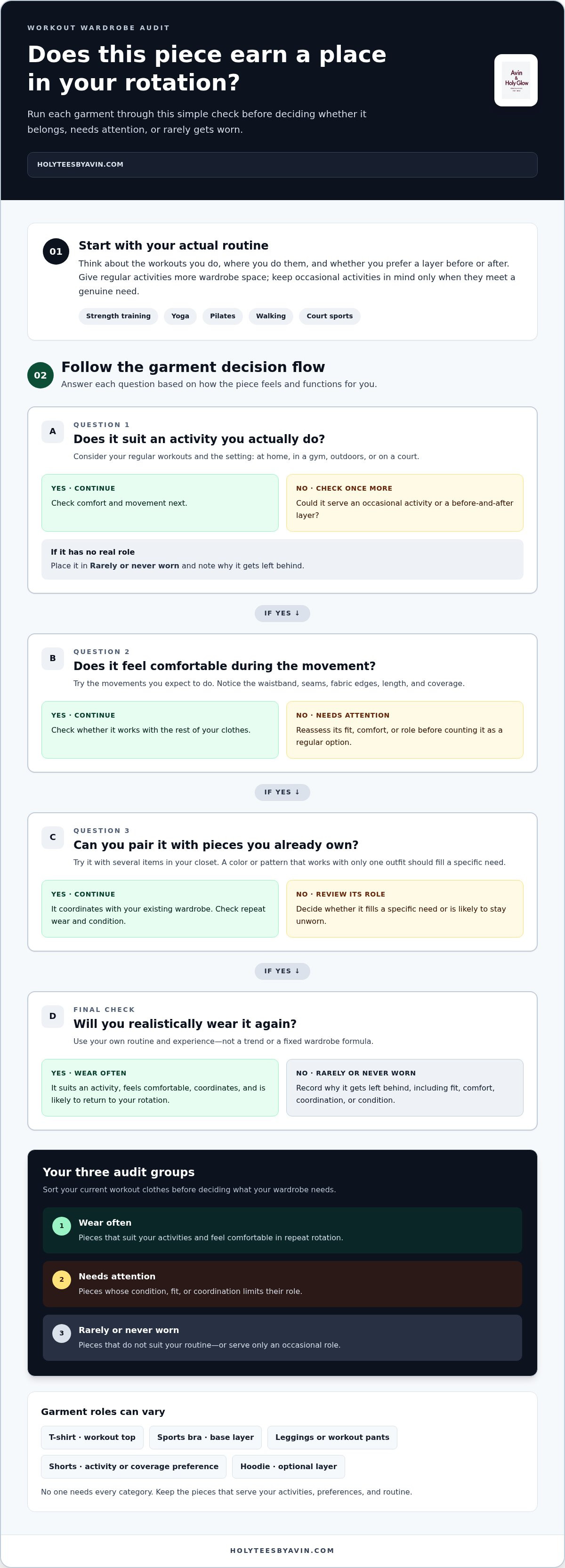
Take stock before adding anything. Sort your clothes into three groups: wear often, needs attention, and rarely or never worn. For each garment, record how it fits, how comfortable it feels, whether it coordinates with other pieces, and its current condition. Use your own notes to identify why something gets worn or left behind.
- Wear often: Notice which pieces suit your activities and feel comfortable in repeat rotation.
- Needs attention: Decide whether a garment is still useful or whether its condition, fit, or coordination limits its role.
- Rarely or never worn: Consider whether it serves an occasional activity or simply doesn’t suit your routine.
This audit may reveal that you need a replacement, a better-fitting option, or no new item at all. If faith is part of how you choose what to wear, Christian activewear: what to look for when choosing modest workout clothes offers a related perspective as you define your criteria.
Choose Workout Wardrobe Pieces by Comfort, Fit, and Garment Role
Once you know what you reach for, judge each piece by how it feels and functions, not by its label or trend appeal. A capsule garment earns its place if it fits comfortably, coordinates with clothes you own, suits at least one real activity, and is likely to be worn again. This practical filter keeps how to build a capsule workout wardrobe 2026 focused on your needs rather than an arbitrary shopping list.
Think of each garment as having a role. A T-shirt may be a go-to top for one workout; a sports bra may be a preferred base layer; leggings, yoga pants, or shorts may suit different activities or coverage preferences. An optional hoodie or other layer may be useful before or after exercise. No one needs every category, and extra coverage is a personal choice, not a universal requirement.
Match garment roles to movement and personal preference
Try a garment in the movements you expect to do, and notice whether you can move comfortably without needing to adjust it. Check how the waistband feels when you bend, whether seams or fabric edges distract you, and whether the garment’s length and coverage match your preference. A piece that feels comfortable for yoga may not be the one you choose for walking or court sports. Let your own experience guide the decision rather than assuming a style guarantees a particular result.
- Tops: Check whether the length, sleeves, and fit feel right for the activity.
- Leggings or workout pants: Notice waistband comfort and ease of movement.
- Sports bras: Choose based on your personal fit and comfort needs.
- Shorts: Consider your preferred coverage and whether the length feels suitable.
- Optional layers: Keep a hoodie or other layer if it serves your routine.
Build a color palette that makes outfits easy to combine
A coordinated palette can make getting dressed simpler, but it doesn’t need to be complicated. Choose a few colors that work with pieces already in your closet. A neutral base with one or two accent colors is one option; a wardrobe built around brighter shades or patterns can work just as well. Color analysis may inspire your choices, but it isn’t a requirement. Fashion coverage of capsule dressing also highlights the appeal of minimizing decision fatigue with versatile pieces.
Before adding a color or pattern, try pairing it with several items you already own. If it only works with one outfit, consider whether it fills a specific need or will mostly sit unworn. If faith is part of your style criteria, you can also explore Christian-inspired activewear as you consider which pieces feel right for your wardrobe.
Compare Workout Wardrobe Options Before Adding Anything New
A garment can look useful in isolation and still leave you with nothing to pair it with. Before buying, compare each candidate with what you own and the workouts you actually do. This makes how to build a capsule workout wardrobe 2026 a practical decision process: assess fit, comfort, activity use, coordination, and the chance you’ll wear it repeatedly.
| Option | Possible role | What to check |
|---|---|---|
| Versatile basic | A top or bottom that works with several pieces you already wear. | Does it feel right for your regular activities and make more than one outfit? |
| Activity-specific piece | A garment chosen for a recurring activity or a particular comfort preference. | Does it fill a real gap, or duplicate something you already reach for? |
| Optional layer | An extra piece for before, after, or during workouts when you prefer another layer. | Will you use it in your routine, and does it coordinate with your workout clothes? |
When a versatile basic makes more sense than a specialized piece
Test a basic against your own closet. Choose a T-shirt, leggings, or yoga pants and see whether you can pair it with several tops or bottoms you already wear for suitable activities. Versatility is real when those combinations feel comfortable and make sense for your routine, not simply because the garment could theoretically serve more than one purpose. A basic that gets repeat wear across your regular workouts may be more useful than a specialized item that rarely leaves the drawer.
When an activity-specific item may earn a place
A specialized garment can be a thoughtful addition if you regularly do an activity and your current options don’t meet a clear fit or comfort need. Before adding it, name the gap: perhaps you want a different length for court sports, or a separate pair of shorts for a recurring workout. Then compare the candidate with your existing clothes. If it solves a genuine need, feels comfortable, and coordinates with other pieces, it may earn a place even if its role is narrower. For more context on choosing faith-centered workout clothing, see the Christian fitness apparel guide.
Keep the decision grounded in what you’ll wear. If faith-based activewear is part of your criteria, you can explore Christian-inspired activewear as one option while building combinations around your own preferences.
Build Your Capsule Workout Wardrobe With a Simple Step-by-Step Plan
A clear process turns your wardrobe audit into a practical plan. The goal isn’t to hit a universal item count. Your needs depend on which activities recur, how often you do laundry, and which garments feel comfortable enough to wear again. Use these steps to decide what stays, what needs attention, and whether anything is genuinely missing.
- Audit what you own. Note the clothes you wear regularly, the pieces that need attention, and those that rarely leave the drawer.
- Map your real routine. List your usual workout days, activities, and settings. Include layering preferences and how laundry fits into the week.
- Mark wardrobe roles. For each activity, consider the tops, bottoms, sports bras, shorts, or optional layers you prefer. Mark each role as covered, missing, or worth reconsidering.
- Identify true gaps. Check whether a missing role affects a regular activity or only an occasional one. Don’t let a workout you rarely do drive additions to your everyday rotation.
- Shortlist and test. Before buying, compare possible additions with your needs and the clothes you already wear. Set personal shopping boundaries, such as buying only to fill a clearly identified gap.
Turn your weekly routine into a capsule checklist
Build the checklist around the week you actually live, not a future routine you may or may not adopt. If you regularly do yoga and strength training, record those activities and the clothing roles you prefer for each. If court sports are occasional, note them separately. Then consider laundry: a longer interval between wash days may change how many repeat-wear options feel practical for you. Let your schedule, not a fixed capsule formula, guide quantity.
Test outfit combinations before you shop
Make a simple outfit grid. List your tops down one side and bottoms across the top, then mark combinations you’d wear for a specific workout. Try those pairings on where possible and note whether they feel comfortable and suitable for the activity. A grid can reveal that several pieces already work together, or show that a needed role has few usable combinations.
Only add a garment if the test reveals a meaningful gap. For example, if a top works with one bottom but not the others, consider whether that limitation matters for your actual routine before replacing anything. If you’re ready to consider faith-based options, explore Christian-inspired activewear across T-shirts, hoodies, gym leggings, sports bras, yoga pants, and shorts.
Maintain a Capsule Workout Wardrobe That Reflects Your Style
A capsule should keep serving you, not become another set of rules. As your workouts, fit preferences, or clothing needs change, review what you actually wear and decide whether each piece still belongs. This is the final step in how to build a capsule workout wardrobe 2026: keep the useful pieces, reconsider the rest, and let your routine lead.
Keep the capsule useful as your routine changes
Pay attention to wear patterns rather than replacing clothes on a fixed schedule. If you’ve stopped doing a particular activity, or a garment no longer feels comfortable, consider whether it still has a place in your rotation. A change in condition can also affect whether you reach for a piece. Before deciding, check its care label and follow the garment-specific guidance. Don’t assume every item needs the same care.
A simple review can be brief: Which pieces did you wear? Which stayed unused? Has your routine or fit preference shifted? These questions can help you choose whether to keep, set aside, or replace a garment without turning upkeep into another shopping cycle.
Choose activewear that feels like you
Function matters, but personal style does too. If Christian-inspired apparel reflects your values and the way you want to dress, it can be part of your capsule. If it doesn’t, there’s no need to include it. Your wardrobe should feel comfortable and considered, not like someone else’s formula.
Avin & Holy Glow offers categories such as T-shirts, hoodies, leggings, sports bras, and tennis dresses. These are options to explore, not a required capsule or a promise that any item will suit every activity or preference. Check current garment details and care guidance when considering a particular piece.
Keep the standard simple: does it fit your routine, feel right to wear, and work with your existing clothes? If faith-based activewear is part of your personal style, explore Avin & Holy Glow activewear and consider which categories, if any, belong in your rotation.
Build a Workout Wardrobe You’ll Reach for Again
A capsule works best when it reflects your real life. Start with the activities you do, then choose pieces that feel comfortable, fit your preferences, and work with clothes you already own. A simple outfit grid can reveal which garments earn repeat wear and where a genuine gap remains. Let your laundry routine help guide quantity, and revisit the lineup if your habits or fit preferences change.
That’s the heart of how to build a capsule workout wardrobe 2026: make thoughtful choices instead of following a fixed item count. Keep what serves you, reconsider what doesn’t, and follow each garment’s care label. Your workout clothes can be practical and personal, including faith-based style if that matters to you.
Holy Tees by Avin offers Christian-inspired activewear in categories such as T-shirts, hoodies, gym leggings, sports bras, yoga pants, shorts, and tennis dresses. Explore the options and decide what fits your own routine: Explore Christian activewear from Holy Tees by Avin.
Start with what you have. Build with intention, and let your wardrobe support the movement and style that feel right for you.
Frequently Asked Questions
How many pieces should be in a capsule workout wardrobe?
There’s no universal piece count. For how to build a capsule workout wardrobe 2026, base the quantity on your weekly activities, how often you wear each garment, and your laundry routine. If several workouts fall between wash days, you may want more rotation options than someone who does laundry after each session. Start with what you use now, then add only when you find a practical gap.
What should a capsule workout wardrobe include?
Include garments that suit your activities and feel comfortable to wear: perhaps T-shirts, leggings or yoga pants, sports bras, shorts, and an optional hoodie or other layer. Court sports may call for a tennis dress if that suits your preference. These are possible roles, not a mandatory list. Holy Tees by Avin offers Christian-inspired activewear in categories such as T-shirts, gym leggings, sports bras, and tennis dresses.
How do I choose workout clothes for different activities?
Start with the movement and setting. For each activity, consider your preferred range of motion and coverage, and whether the waistband, seams, and garment length feel comfortable as you move. Try existing clothes during the activities you do, then note what feels suitable and what you adjust or avoid. Choose based on your own experience rather than assuming one garment works equally well for every workout.
Can I build a workout capsule from clothes I already own?
Yes. Begin by sorting your workout clothes into pieces you wear often, pieces that need attention, and pieces you rarely choose. Note each item’s fit, comfort, condition, and how easily it pairs with the rest of your wardrobe. Then create outfits for your regular activities from what you already have. You may find that the capsule is mostly in place, with only one or two genuine gaps to consider.
How do I make workout clothes mix and match?
Choose colors that coordinate with garments already in your closet, then test combinations before buying anything. Lay out a top with each suitable bottom and note which pairings you’d actually wear for your workouts. A neutral base with a few accent colors is one approach, but it isn’t a rule. Focus on combinations that feel comfortable and useful, rather than choosing colors only because they’re popular or appear versatile.
Are capsule workout wardrobes suitable for different kinds of exercise?
Yes. A capsule can serve different kinds of exercise if you choose pieces around the activities you actually do. You might use some garments across several workouts and keep a more specific option for a recurring activity with different comfort or coverage needs. The aim isn’t to make every item work everywhere. It’s to build a coordinated rotation that fits your routine without adding pieces for activities you rarely do.
How often should I update my workout wardrobe?
Review your workout clothes when your routine, fit preferences, or garment condition changes, rather than replacing items on a fixed schedule. Notice which pieces you reach for and which stay unused. Reconsider garments that no longer suit your activities or feel comfortable, and check each care label for item-specific guidance. A thoughtful review can show whether you need a replacement, a different option, or no new clothing at all.

Article by
Avin
Avin is the founder and visionary behind Holy Tees by Avin, a Black woman-owned Brooklyn brand that uniquely bridges the worlds of expressive streetwear and ethical beauty. Driven by a mission to offer premium style without compromising on values, Avin curated a collection that features quality activewear, hoodies, and graphic tees paired alongside a dedicated line of vegan and cruelty-free cosmetics. Through her platform, she champions mindful living, creating high-performance skincare and beauty products that celebrate clean ingredients and sacred self-care.