
A sharper-looking lip doesn’t always require a sharper pencil. An automatic lip liner uses a retractable, twist-up format, so you can define your lips without reaching for a separate sharpener. Still, choosing one can raise questions: How should it differ from a traditional pencil, and which shade will complement your lipstick or gloss?
The details matter. A flattering shade and light, controlled strokes can help create an even outline, while careful handling can reduce the chance of a tip breaking or color feathering beyond the lip line. In this guide, you’ll learn how automatic lip liners work, which features to compare, and how to choose a shade that suits your natural lip color and preferred finish.
You’ll also find a simple application routine, from outlining and blending to pairing your liner with lipstick or gloss, plus practical tips for handling and storage. Avin & Holy Glow offers automatic lip liners as part of a wider beauty range that includes lipsticks, lip gloss, and hydrating lip oils, so lip definition can be one considered step in your routine.
Key Takeaways
- An automatic lip liner advances with a twist, offering a different routine from sharpening a traditional pencil.
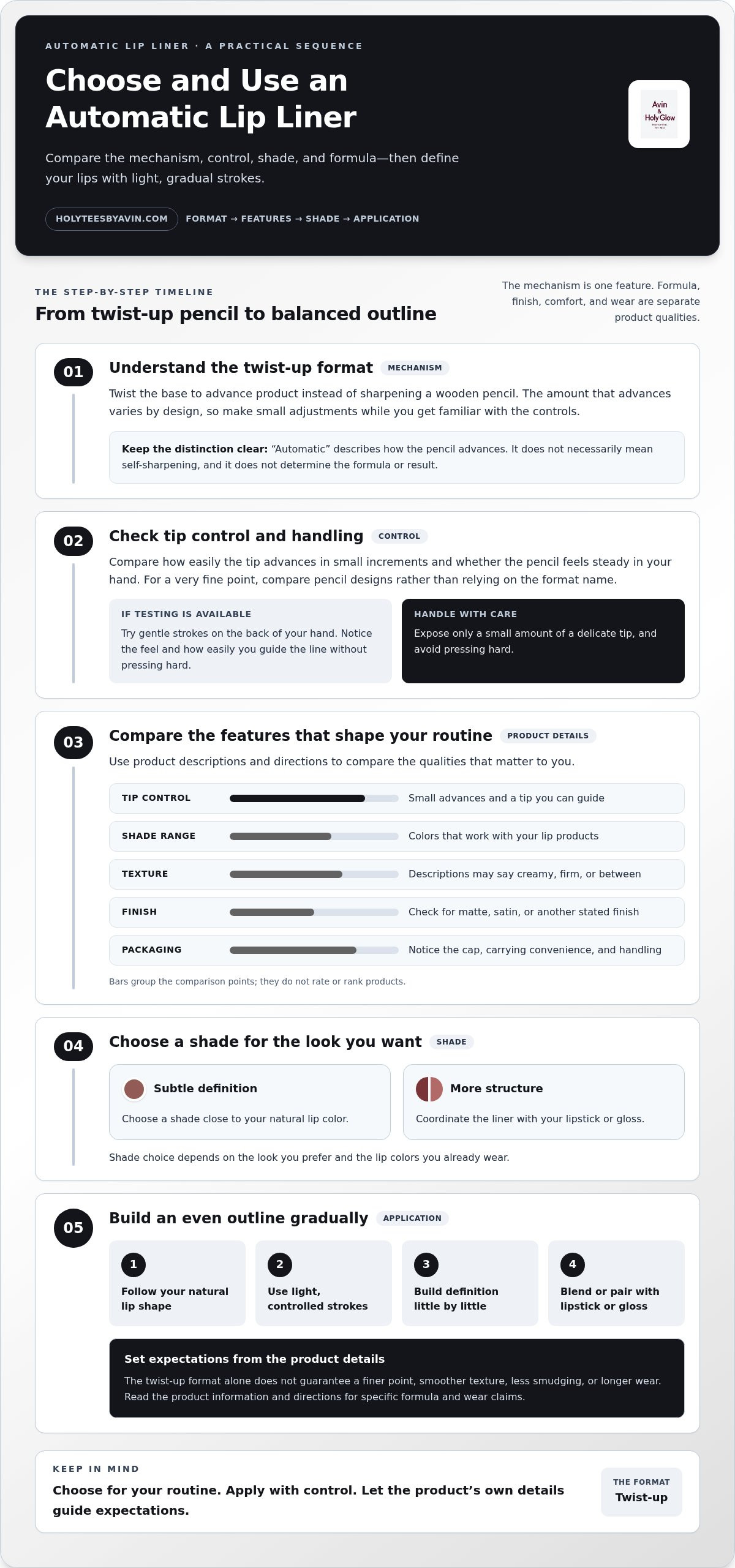
- Compare tip control, shade options, texture, finish, and packaging to find an automatic lip liner that fits your makeup routine.
- Choose a shade close to your natural lip color for subtle definition, or coordinate with lipstick for a more structured look.
- Follow your natural lip shape, use light strokes, and build definition gradually for a balanced outline.
- Use product labels and directions to guide your expectations about formula, comfort, and wear.
What Is an Automatic Lip Liner, and How Does Its Twist-Up Format Work?
An automatic lip liner is a lip-defining pencil with a mechanism that advances the product from its casing, commonly by twisting the base. Instead of using a sharpener to expose more pigment, you turn the pencil to bring the tip forward as needed. The amount it advances varies by design, so make small adjustments until you’re familiar with the controls.
The format changes how you access the tip, not what the liner is made of or how it performs. An automatic mechanism describes how the pencil advances; it doesn’t determine the formula, finish, comfort, or wear. Those qualities depend on the individual product. For a foundation on what lip liner does, see What is lip liner?
That distinction helps set useful expectations. A twist-up design may save you the step of sharpening before application, but it doesn’t automatically make the point finer, the texture smoother, or the result longer lasting. Treat the mechanism as one practical feature among several, then assess how the product feels and applies.
Automatic, retractable, and traditional lip liner: what differs?
A conventional wooden pencil is sharpened to expose fresh product and shape its point. An automatic design advances product through a built-in mechanism. Some also let you retract the tip, while others may have different controls. “Automatic” doesn’t necessarily mean “self-sharpening.” That claim refers to a separate feature and should be supported by the product’s own details.
For a bag or quick touch-up, a compact pencil that’s ready without a sharpener may suit your routine. A traditional pencil lets you reshape the tip with a sharpener. Neither format is universally better. Consider what you’ll carry, how much preparation you prefer, and whether the mechanism feels steady in your hand.
Who may prefer an automatic lip liner?
If you value quick access to a defined tip and a compact makeup bag, an automatic lip liner may feel convenient. It can also suit a routine where you want to define your lips without carrying a separate sharpener. But a twist-up format isn’t automatically the best choice for every technique or preference.
For a very fine point, compare pencil designs rather than relying on the format name. Check how the tip looks when advanced and whether the control feels comfortable as you guide it along your lip line. If the tip seems delicate, expose only a small amount at a time and avoid pressing hard. Application should feel manageable, not rushed.
Holy Tees by Avin offers automatic lip liners alongside lipsticks, lip gloss, and hydrating lip oils. Consider the pencil’s mechanism, your preferred level of control, and the rest of your look when choosing how liner fits into your routine.
Which Automatic Lip Liner Features Matter for Your Makeup Routine?
Choose by how you’ll use it, not by the boldest claim on the package. A useful comparison considers tip control, shade options, texture, finish, and packaging together. A pencil for quick everyday definition may not be the same one you’d reach for when shaping a more detailed lip look.
The mechanism tells you how the liner is dispensed; the formula, finish, and stated wear describe separate product qualities. Keep that distinction in mind as you compare options: a twist-up design alone can’t tell you how the color will feel or look on your lips.
- Tip control: Consider whether the tip is easy to advance in small increments and guide along the lip line.
- Shade range: Look for colors that coordinate with the lipsticks or glosses you already wear.
- Texture: Product descriptions may indicate whether a liner feels creamy, firm, or somewhere between the two.
- Finish: Check whether the product is described as matte, satin, or another finish.
- Packaging: Notice how the cap fits and whether the pencil is convenient to carry and handle.
Let your routine set the priorities. If you wear liner occasionally, a comfortable feel and a shade that works with several lip colors may matter most. For everyday use, focus on easy handling and a finish you enjoy wearing. If you like detailed definition, prioritize tip control and the ability to make light, deliberate strokes. There’s no single checklist that fits everyone.
How should you assess tip control and texture?
If in-store testing is available, try a few gentle strokes on the back of your hand. Notice whether the tip moves smoothly and whether you can control the line without pressing hard. A strong pigment claim may sound appealing, but steady application and a comfortable feel can be more useful in practice. This test can’t predict exactly how the liner will apply on your lips, so treat it as one comparison, not a guarantee.
Don’t assume the mechanism will prevent skipping, smudging, or breakage. Those results can depend on the product and how it’s handled. When comparing pencils, notice how the tip responds to a light touch rather than forcing it to make a mark.
What do finish and wear claims really tell you?
A matte finish is typically described as less reflective than a satin finish, while satin suggests a soft sheen. Other finish terms can vary, so use the product’s own description to understand what’s being claimed. Comfort is personal, too. Texture and feel depend on the formula, and a finish label alone won’t tell you how it will wear on your lips.
Read product information and directions for specific claims such as waterproof or long-wear. Don’t infer those qualities from the twist-up format, a color description, or a familiar ingredient. For a coordinated lip routine, explore lip liners and lip color together, then choose the features that suit your preferences.
How Do You Choose an Automatic Lip Liner Shade That Works?
Start with the effect you want, then compare the liner with your natural lip tone and the lipstick or gloss you plan to wear. A shade close to your lips can add subtle definition; a coordinated liner can make the outline feel more structured. Neither approach is limited to a particular skin tone. Your lip color, chosen makeup, and personal preference all shape the result.
Use this simple framework to narrow your options:
| Approach | How it may look | Try it when |
|---|---|---|
| Close to your natural lip tone | Soft, understated definition | You want a flexible option to wear with different lip colors |
| Matched to lipstick | A coordinated, more defined outline | You want the liner and lipstick to read as a unified look |
| Contrasting shade | More visible definition or a deliberate color shift | You’re choosing contrast intentionally and want to test how it looks with your lip color |
Should your liner match your lipstick or your natural lip tone?
Both choices can work. A liner close to your natural lip tone may give a low-key edge, while one that matches your lipstick can bring structure to the overall look. For example, compare soft pink or rose tones with lighter shades, warm rose or muted berry options with medium color families, and deeper berry or brown tones with richer shades. These are starting points, not rules based on complexion.
If possible, compare the colors in natural lighting, since indoor light can shift how a shade appears. Check the liner alongside your lipstick rather than judging it alone. A slight difference in depth may create definition, but the final impression depends on both colors and how you apply them.
How can you pair liner with lipstick or lip gloss?
First coordinate the color family: for instance, pair rose with rose, berry with berry, or brown with brown. If you want a cohesive finish, begin with a liner of similar color depth to your lipstick or gloss. Then consider whether a little contrast suits the look you have in mind. A more defined edge is a styling choice, not a requirement.
With gloss, remember that its sheen can change how the combined lip look reads, so try the shades together if you can. Compare the result in natural light and adjust your choice based on the balance you prefer. For related context, the guide The Mindful Guide to Vegan Lip Gloss and Beeswax Lipsticks explores those lip product categories, while Beeswax Lip Liner: Benefits for Long-Lasting Definition focuses on beeswax as a distinct topic. Your liner shade and the rest of your lip color work together to create your chosen finish.
How Do You Apply Automatic Lip Liner for a Clean, Balanced Outline?
A controlled outline starts with a light hand, not a dramatic first pass. Work in small sections and pause to check your shape as you go. An automatic lip liner makes the tip accessible, but your pressure and pace help keep application measured.
What application sequence helps keep the outline even?
Use this order as a simple guide:
- Prepare your lips. Begin with clean, dry lips so you can see their natural edges clearly. Settle in front of a mirror with enough light to compare both sides.
- Advance only the needed tip. Twist or adjust the pencil according to its design, exposing a small amount. Keeping the tip close to the casing helps avoid applying with more product extended than you need.
- Map the natural shape. Start at the Cupid’s bow, then use short, light strokes along the upper lip. Trace the lower lip in small sections, following its natural edge rather than trying to redraw the whole shape at once.
- Compare before building. Relax your mouth and look at both sides from the front. If one area needs more definition, add a little at a time instead of pressing harder or drawing a single heavy line.
- Fill or blend, if desired. Use the side of the tip to lightly fill the lips for a more continuous base, or soften the outline inward with a clean fingertip or makeup tool.
- Finish with lip color. Apply lipstick or gloss over the liner, keeping the color within the outline. Start with a light layer, then assess the overall look before adding more.
Let the first pass be a guide. You can refine it gradually, while a heavy line is harder to soften evenly. Keeping your lips relaxed also helps you see the shape as it will appear when you’re not stretching your mouth to apply the product.
How can you correct an uneven line or avoid overlining?
If a small section looks uneven, soften it with a clean fingertip or makeup tool, then redraw only where needed. Check the center and corners of the lips as well as the Cupid’s bow; a small adjustment in one area may be all that’s needed to balance the outline. Avoid extending the line far beyond your natural lip shape on the first pass. Subtle changes are easier to assess and build on.
For a more continuous base, fill the lip lightly rather than pressing down to create a dense layer. Blend toward the center if you want the edge to look softer, or leave it more defined under lipstick. Gloss can add shine over the finished liner, while lipstick provides another layer of color. Keep the application controlled, then let the combined look guide any final touch-ups.
Build a lip routine around careful definition with Holy Tees by Avin lip products, including automatic lip liners, lipsticks, lip gloss, and hydrating lip oils.
How Can You Make Automatic Lip Liner Part of a Considered Lip Routine?
A liner can be a small step in a simple lip routine or the foundation for a more defined look. Use it alone for a softly shaped edge, or layer it with another lip product when you want a more finished effect. Let your preferred routine guide how much definition you add, rather than expecting the pencil format to guarantee a particular result.
Holy Tees by Avin offers automatic lip liners alongside lipsticks, gloss, and hydrating lip oils. Keep product-specific expectations grounded in the label and directions: ingredients, application guidance, finish, and wear claims vary by product. Don’t assume a liner has a particular formula or benefit just because it twists up.
How can liner work with different lip products?
Think about order and texture. Apply liner first, then choose a finishing product based on the look you want. Lipstick can create a more complete color look; gloss or lip oil can bring a sheen over the defined edge. You can also wear liner without another lip color if that suits your routine. Apply the next product in a light layer, then decide whether you want to add more.
If you’re wearing matte lipstick, keep the application deliberate and follow the product’s directions. For a focused discussion of that lipstick type, see The Ultimate Guide to Long-Lasting Matte Lipstick. The goal isn’t to layer every product, but to choose the steps that feel comfortable and work together for the finish you want.
How should you handle and store a twist-up liner?
Advance only a small amount of product while applying. This limits how much of the tip is exposed and gives you a manageable point to guide. After use, replace the cap securely and keep the liner clean and dry. Follow the package directions for any product-specific handling or storage instructions.
Pay attention to changes. If the product’s texture or smell changes noticeably, stop using it and replace it. Keep the cap and casing free of residue, and avoid leaving the exposed tip out between steps. These habits help keep your routine tidy without assuming the mechanism or formula has features the product label doesn’t state.
Whether your routine is a quick outline or a layered lip look, choose the steps that suit you and let the product directions guide its use. Explore Holy Tees by Avin beauty products to discover lip liners and complementary lip color options.
Make Your Next Lip Look Your Own
Let your next application be an experiment in personal style. Try a soft outline for a subtle finish, or build more definition when the moment calls for it. An automatic lip liner can be part of either approach, but the best routine is the one that feels natural in your hands and reflects how you want to show up.
Give yourself room to adjust. A different lip color, a lighter touch, or a change in how you blend can shift the look without requiring a whole new routine. Over time, you’ll learn which details make your lip color feel considered and distinctly yours.
Holy Tees by Avin is a Black woman-owned beauty brand offering lip liners and related lip makeup. Ready to choose a liner and build a lip look that feels like you? Explore lip products from Holy Tees by Avin and find a liner to suit your routine.
Frequently Asked Questions
Does an automatic lip liner need sharpening?
Usually, an automatic lip liner advances product through a twist or similar mechanism, so it doesn’t need conventional pencil sharpening. Designs differ: a pencil may have a separate sharpener or controls that work differently. Check the package before adjusting it, and expose only the amount of tip you need. A long exposed point can be more vulnerable to pressure or damage, especially if you press firmly while applying.
Is an automatic lip liner the same as a retractable lip liner?
The terms often describe liners that advance from a casing instead of being sharpened like a wooden pencil, but they don’t guarantee identical controls. One design may twist up, another may retract, and some may not retract once advanced. Read the package before turning or pushing the mechanism. When comparing pencils, focus on how the tip moves and whether its controls suit the way you apply makeup.
Can you use lip liner all over your lips?
Some people use liner across the lips as a base or as the main color, but not every product is designed for that purpose. Start with a light layer and check how the texture feels before covering more area. You could test a small section first, then decide whether to continue or layer lipstick or gloss over it. Follow the liner’s directions rather than assuming it replaces lip color.
Can you wear automatic lip liner under lip gloss?
Yes, you can pair liner with gloss if the combination suits your desired look. Apply the liner with light strokes, then dab or glide the gloss over the lips without pulling at the outline. A similar color can create a coordinated effect, while a contrasting one can make the edge more noticeable. If either product includes layering directions, follow them and try the pairing gently before applying more.
What should you do if an automatic lip liner tip breaks?
Stop applying pressure and check the package for instructions specific to that pencil. A tip can break if too much is exposed, if it’s pressed firmly, or if the product is dropped, though the cause can vary. Retract the tip only if the mechanism is designed to do so. Keep the pencil capped, and don’t apply product with a damaged or contaminated tip.
How do you remove automatic lip liner at the end of the day?
Use a makeup remover or cleanser intended for the lip makeup you’re wearing, and follow its directions. Work gently over the lips instead of scrubbing; if color remains, repeat the process rather than increasing pressure. Rinse or wipe only as the remover’s instructions indicate. Stop using it if irritation occurs, and follow the product label for guidance on safe use.
How long does automatic lip liner last after opening?
There isn’t one timeline that applies to every liner. Check the packaging for its period-after-opening symbol, expiration guidance, and storage directions. Keep the cap on and avoid sharing lip products. If the liner’s texture, smell, or appearance changes noticeably, discontinue use instead of trying to extend its life. The package is the best source for care guidance specific to that product.

Article by
Avin
Avin is the founder and visionary behind Holy Tees by Avin, a Black woman-owned Brooklyn brand that uniquely bridges the worlds of expressive streetwear and ethical beauty. Driven by a mission to offer premium style without compromising on values, Avin curated a collection that features quality activewear, hoodies, and graphic tees paired alongside a dedicated line of vegan and cruelty-free cosmetics. Through her platform, she champions mindful living, creating high-performance skincare and beauty products that celebrate clean ingredients and sacred self-care.